Every mature AI governance framework, NIST AI RMF, ISO 42001, the Colorado AI Act, assumes a governance function with real authority. The framework is the spine. The committee is the heart.
Most US enterprises that say they have AI governance actually have a policy document and a senior leader who is nominally accountable. The committee meeting cadence is irregular. Decision rights are unclear. Escalation paths are theoretical. When a real AI incident hits, governance does not move at the speed the moment requires.
This article walks through what a working AI governance committee actually looks like, structure, membership, charter, cadence, decision rights, escalation. The architecture varies by enterprise size and AI maturity, but the underlying requirements are consistent.
What the committee is for
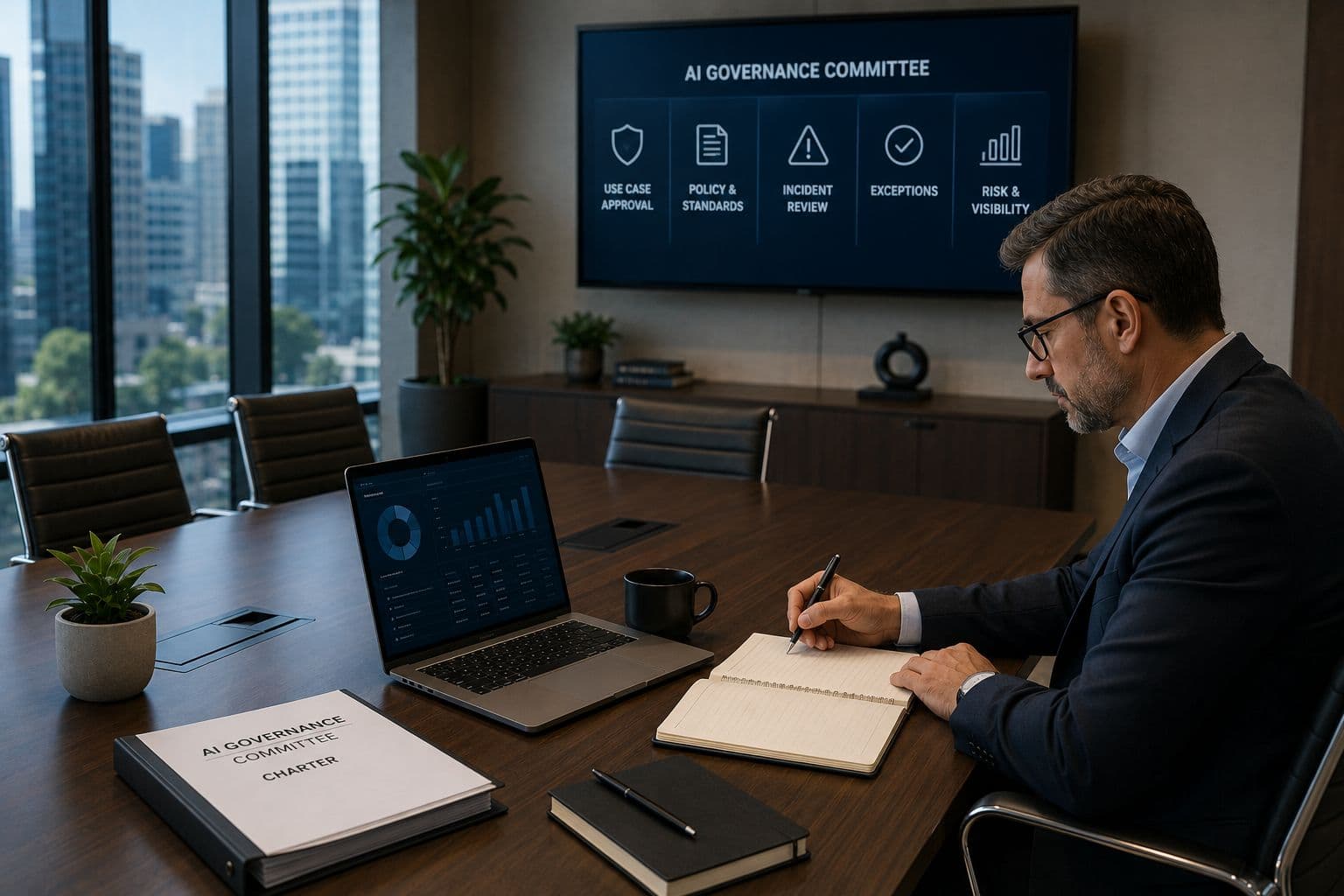
An AI governance committee exists to do five things.
● Approve or reject AI use cases above defined risk thresholds
● Set policy and standards for AI development, procurement, and deployment
● Review AI incidents and remediation actions
● Approve or escalate exceptions to AI policy
● Provide visibility to executive leadership and the board on the AI risk and capability portfolio
Anything else the committee does, strategic discussions, vendor selections, educational sessions, is secondary. If the committee cannot do these five things effectively, the governance program is not working regardless of how many meetings it holds.
Committee membership
The right membership balances cross-functional authority with operational decisiveness. A committee with 20 members from 18 functions cannot make decisions. A committee with 4 members from 4 functions cannot represent the breadth of AI considerations.
Standard membership at a mid-to-large US enterprise:
● Chair, Chief AI Officer, Chief Data Officer, or equivalent, with named accountability for the AI governance program
● CIO or CTO, for technology architecture, infrastructure, and engineering accountability
● CISO, for AI security, data protection, and incident response
● Chief Privacy Officer, for federal and state privacy regulation interaction with AI
● General Counsel or designated AI legal lead, for regulatory interpretation, contracts, and litigation risk
● Chief Risk Officer or equivalent, for enterprise risk integration
● Chief Compliance Officer, for regulatory examination readiness
● Head of HR, for hiring AI, workforce AI, and employee impact of AI deployments
● Head of Internal Audit, typically as a non-voting observer for assurance independence
● Business unit leaders, rotating or standing seats for the business areas most affected by AI
Smaller enterprises consolidate roles. Larger enterprises may add specialist roles (Head of Responsible AI, AI Ethics Officer, dedicated AI Risk Officer). The principle, every function with a stake in AI risk has a voice; the voices that matter most have decision rights.
Committee charter
The charter is the foundation document. Without a charter, the committee operates on assumption, which is the root cause of most governance failures. A charter should document:
● Mission and scope, what the committee is responsible for, and what it explicitly is not
● Membership, including voting versus non-voting roles, quorum requirements, delegation rules
● Meeting cadence, typically monthly for active programs, with provision for ad-hoc meetings on urgent matters
● Decision rights, what the committee can approve, what requires escalation, what is delegated to operating teams
● Escalation paths, to executive committee, to the board, to specific board committees (Audit, Risk, Technology)
● Reporting obligations, internal reporting to executive committee and board; external reporting to regulators where applicable
● Review and amendment process for the charter itself
Decision rights
The committee's effectiveness depends on clarity about what it actually decides. Three categories typically apply:
Committee decisions
High-risk AI use case approval or rejection, AI policy changes, AI vendor selection at material spend levels, AI incident remediation approval above defined thresholds.
Delegated decisions
Medium-risk AI use cases (typically delegated to business unit AI leads with documented criteria), routine vendor renewals, minor policy interpretations.
Escalated decisions
Material regulatory engagements, AI-related litigation matters, AI use cases that touch board-level risk appetite, major AI vendor terminations or transitions.
The wrong pattern is, every decision routes to the committee, which becomes a bottleneck; or nothing routes to the committee, which means the committee adds no value. Defining the lanes clearly is the work of the chair and the charter.
Meeting cadence and operating rhythm
For active AI governance programs, monthly committee meetings are the standard. A typical monthly agenda includes, AI use cases requiring committee approval (typically 2-5 per month at scale), AI incidents from the prior period and remediation status, policy and standards updates, regulatory developments (state laws, federal guidance, enforcement actions), and an AI portfolio risk dashboard.
Quarterly meetings should add, strategic portfolio review, vendor relationship review, training and awareness program updates, board-level reporting preparation.
Annual meetings should add, charter review, full risk reassessment, framework adoption review (NIST AI RMF maturity, ISO 42001 if applicable), policy stack review and refresh.
Common failure patterns
● Charter exists but is not followed, committee decisions made outside charter authority, or charter authority not exercised
● Membership is too broad, committee becomes a discussion forum that cannot make decisions
● Membership is too narrow, committee makes decisions but lacks the cross-functional input to make them well
● Meetings happen on cadence but nothing is actually decided, committee becomes performative
● Decisions are made but not documented, leaving no evidence base for regulatory inquiry
● No connection to executive committee or board, leaving senior leadership unaware of material AI risk
● Chair does not have actual authority, committee decisions get reversed or ignored by operating teams
The shift to make
Stop treating AI governance as a policy document with a senior name attached.
Start treating it as an operating function, a real committee with a real charter, real decision rights, real meeting cadence, real documentation, and a real escalation path to executive leadership and the board.
Enterprises that build the governance committee well gain the throughput advantage that compounds over years. AI decisions get made faster because the venue and decision rights are clear. AI incidents get triaged faster because escalation paths work. Regulatory examinations go better because the evidence base exists. And executive leadership has actual visibility into the AI risk and capability portfolio rather than discovering issues after the fact.