

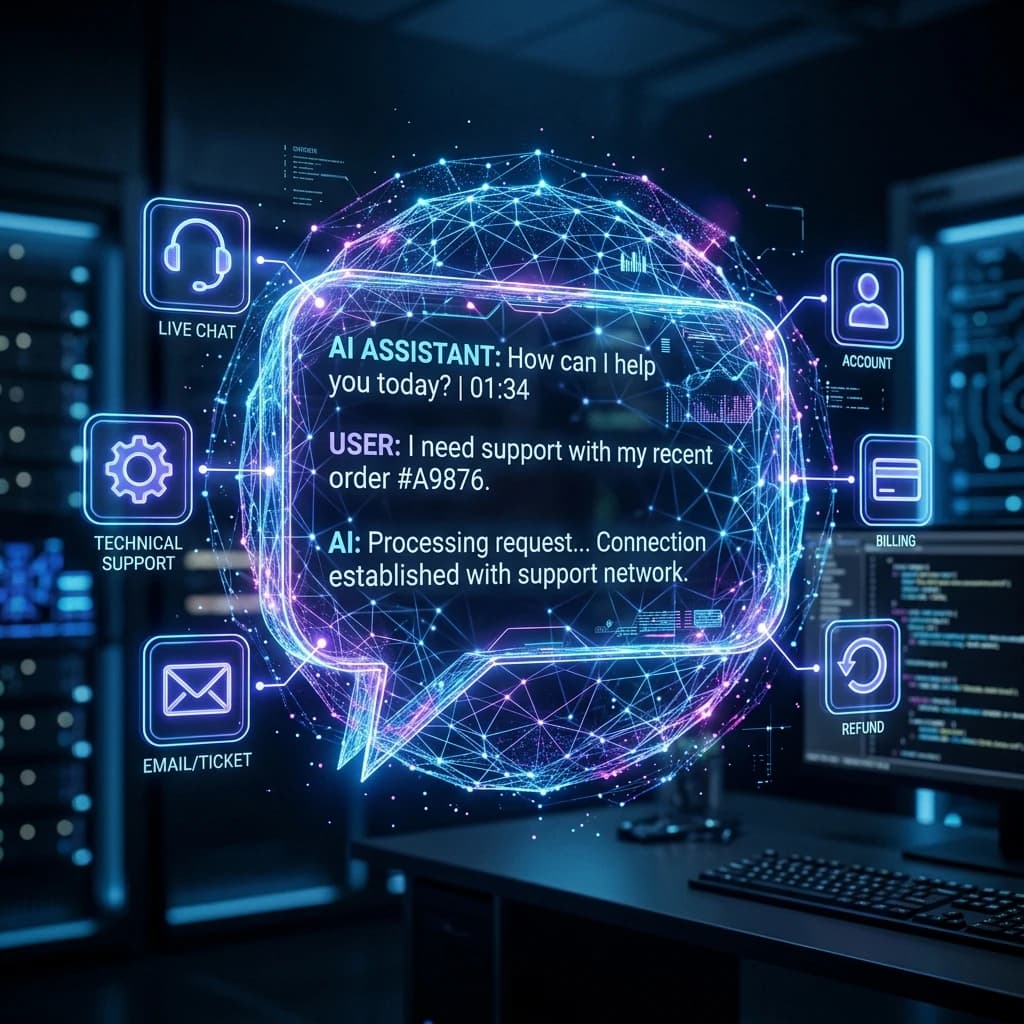
AI Assistant and Chatbot Development Services for Enterprise Conversations
Turn customer questions, employee requests, sales inquiries, and support interactions into fast, context-aware conversations connected to your business systems.
Mobiloitte designs and develops custom AI assistants and enterprise chatbots that understand user intent, retrieve information from approved sources, complete permitted actions, and transfer complex conversations to the right human team with full context.
From customer service and lead qualification to employee self-service, product assistance, appointment scheduling, and internal knowledge access, we build conversational AI around your users, data, workflows, systems, brand, and governance requirements.
Start with one high-value conversation and build toward a connected enterprise assistant.
Grounded in Your Knowledge
Deliver responses based on approved policies, product information, documents, databases, and business systems.
Connected to Your Workflows
Allow assistants to retrieve records, create tickets, qualify leads, schedule appointments, and initiate approved actions.
Governed by Your Rules
Control what the assistant can access, say, recommend, update, and escalate.
Measured and Improved
Track conversation quality, resolution, escalation, user feedback, conversion, and operational performance.
Move Beyond Scripted Chatbots and Generic AI Responses
Traditional chatbots follow fixed menus and predefined answers. They work for simple questions, but they often fail when a user changes direction, asks a contextual question, or needs information from a business system.
Generic AI tools can hold natural conversations, but they may not understand your products, policies, users, terminology, processes, or access restrictions.
A custom enterprise AI assistant brings these capabilities together. It combines natural-language interaction with verified business knowledge, user context, enterprise integrations, workflow automation, guardrails, and human escalation.
Mobiloitte helps organizations build conversational AI systems that do more than generate text. They help users find information, complete tasks, make informed choices, and reach the right person when human assistance is needed.
What Are AI Assistants and Chatbots?
AI assistants and chatbots are conversational software systems that communicate with users through text or voice. A basic chatbot generally follows predefined questions and decision paths, while an AI assistant can interpret natural language, retain context, retrieve information, and execute connected tools.
A Production-Ready Enterprise Assistant Includes:
The appropriate design depends on the use case. Some conversations need a controlled rules-based flow. Others require knowledge retrieval, tool usage, AI reasoning, or a combination of these approaches.
When Your Business Needs an AI Assistant
Common operational hurdles that conversational AI and intelligent assistants solve for organizations.
Customers Ask the Same Questions Repeatedly
Support teams spend time answering routine questions about accounts, billing, pricing, returns, services, availability, and order status. An AI assistant responds immediately and routes exceptions.
Leads Leave Before Sales Responds
Website visitors have questions before completing forms. A sales assistant answers questions, collects requirements, qualifies intent, and schedules meetings while interest is active.
Employees Cannot Find Internal Information
Policies, guides, and operating instructions are spread across drives and portals. An internal knowledge assistant helps employees search approved sources through conversation.
Users Need Help Outside Business Hours
Customers and prospects need guidance when teams are offline. An AI assistant provides initial support, collects information, and prepares conversations for follow-up.
Human Handoffs Lose Important Context
Users repeat issues after chatbot transfers. A connected assistant provides human teams with transcript history, identified intent, collected info, and relevant records.
Conversation Quality Varies Across Channels
Different answers across website, portal, and support teams confuse customers. A shared knowledge and governance layer maintains consistent responses.
Generic AI Cannot Access Business Systems
Off-the-shelf AI cannot check account status, create tickets, update CRM records, or schedule appointments. Custom AI connects conversation with permitted actions.
Existing Chatbots Have Reached Their Limit
Older chatbots have weak intent recognition and poor containment. Mobiloitte assesses and modernizes existing conversational systems without requiring total replacement.
Choose the Right Conversational AI Approach
Not every use case requires the same level of intelligence or autonomy.
Rules-Based Chatbots
Best for predictable conversations with a limited set of options.
- • Basic FAQs
- • Guided form completion
- • Menu-based navigation
- • Simple request routing
Knowledge-Grounded AI
Best for answering questions from approved company information.
- • Product information
- • Policy questions
- • Technical documentation
- • Employee knowledge access
Transactional Assistants
Best for conversations requiring system access or action completion.
- • Checking account / order status
- • Creating support tickets
- • Booking appointments
- • Submitting requests
AI Copilots
Best for assisting employees during live work and customer service.
- • Response recommendations
- • Case summaries
- • Knowledge retrieval
- • Next-best-action guidance
Agentic Assistants
Best for multi-step requests requiring planning and tool coordination.
- • Resolving complex cases
- • Coordinating multiple systems
- • Conditional workflows
- • Prepared human escalation
Our AI Assistant and Chatbot Development Services
Comprehensive capabilities across strategy, engineering, knowledge retrieval, system integration, and governance.
Conversational AI Consulting & Discovery
Determine where conversational AI creates operational and customer value. Includes audience analysis, knowledge assessment, security review, escalation planning, and roadmap definition.
Custom AI Chatbot Development
Develop conversational experiences designed around your business. Includes intent design, generative AI integration, knowledge grounding, API connections, and multichannel delivery.
Enterprise AI Assistant Development
Build assistants for customer-facing and internal use. Search approved knowledge, call authorized APIs, create records, complete workflows, and maintain interaction auditability.
Generative AI Chatbot Development
Use generative AI where conversations need flexibility, context, natural language, or synthesis. Combined with retrieval, rules, and guardrails to reduce unsupported responses.
Retrieval-Augmented Generation (RAG)
Build RAG-based assistants that retrieve relevant information from approved data sources before generating answers. Includes vector search, chunking, reranking, and source attribution.
Customer Service AI Assistants
Provide immediate first-level assistance while maintaining a clear path to human support. Handles FAQ resolution, ticket creation, account assistance, and priority detection.
Sales & Lead Qualification Assistants
Engage website visitors at the moment of interest. Collect requirements, ask qualification questions, recommend offerings, update CRM records, and schedule consultations.
Employee Self-Service Assistants
Internal assistants help employees find information and complete requests without navigating several systems—covering HR, IT helpdesk, policy navigation, and internal forms.
AI Copilot Development
Build copilots that support support agents, sales reps, and operations teams during live work—providing response recommendations, case summaries, and next-best-action guidance.
Multilingual AI Assistant Development
Design conversational experiences for users across languages, including language detection, translated interfaces, multilingual retrieval, and localized tone.
Omnichannel Chatbot Development
Deploy connected conversational experiences across website chat, customer portals, mobile apps, WhatsApp, Slack, Teams, SMS, and voice interfaces with a shared business logic.
Conversational AI Integration Services
Integrate assistants with CRM platforms, customer support systems, ERP applications, scheduling tools, databases, identity providers, and custom enterprise APIs.
AI Assistant and Chatbot Capabilities
Key building blocks that enable reliable, context-aware, and secure enterprise conversations.
Natural-Language Understanding
Interpret user questions conversationally with spelling differences or non-scripted phrasing.
Context-Aware Conversations
Maintain relevant details across conversation steps so users do not repeat details.
Knowledge-Base Grounding
Retrieve verified answers from approved documents, policies, product guides, and records.
Personalized Responses
Use customer or employee account context to provide relevant personalized guidance.
Tool and API Calling
Execute authorized actions directly through connected APIs and enterprise systems.
Intelligent Triage
Identify intent, urgency, sentiment, and complexity to route conversations appropriately.
Human Escalation
Transfer conversations to human agents with full transcripts, intent, and attempted resolutions.
Workflow Initiation
Create tickets, submit requests, schedule appointments, or update records dynamically.
Multichannel Consistency
Maintain shared knowledge, rules, and response standards across digital channels.
Identity-Aware Access
Authenticate users before retrieving or updating private profile or account records.
Role-Based Knowledge Access
Restrict data and actions according to user role, department, or access rights.
Source-Aware Answers
Show or record which approved source contributed to a response for full transparency.
How a Connected Enterprise AI Assistant Operates
Step-by-step lifecycle of an enterprise conversational interaction.
User Starts Conversation
Interaction begins via website, app, portal, messaging, or voice interface.
Intent Identification
Assistant analyzes request, language, context, and conversation history.
Context Retrieval
Searches permitted knowledge sources, customer records, and policy docs.
Response / Action Selection
Answers questions, requests details, calls APIs, or triggers workflows.
Validation & Guardrails
Rules check response data access, disclosures, and action permissions.
Human Approval
High-impact actions are paused and sent to authorized human managers.
Completion or Escalation
Resolves request or transfers user to human agent with complete context.
Interaction Logging
Logs conversation events, retrieved sources, tool calls, and outcomes.
Performance Measurement
Reviews resolution rates, containment, user feedback, and cost.
Continuous Optimization
Updates knowledge bases, guardrails, and prompts based on real usage.
AI Assistant Use Cases Across the Enterprise
Tailored conversational workflows across core business departments.
Customer Service
- • Resolve routine questions & account details
- • Check service or order status
- • Create and update support tickets
- • Priority detection & after-hours inquiries
- • Human escalation with full transcript
Sales & Lead Gen
- • Engage website visitors in real time
- • Collect prospect details & qualify leads
- • Recommend relevant service offerings
- • Schedule consultations & update CRM
- • Prepare sales summaries & follow-ups
Human Resources
- • Answer policy & benefits questions
- • Support employee onboarding guidance
- • Guide leave requests & document intake
- • Route confidential HR requests
- • Assist candidates during recruitment
Information Technology
- • Classify IT support requests
- • Retrieve technical resolution guides
- • Create service tickets & collect diagnostics
- • Password reset & access request routing
- • Escalate security-sensitive issues
Finance & Billing
- • Answer approved invoice questions
- • Retrieve transaction & payment status
- • Route billing disputes & expense forms
- • Find finance policies & procedures
- • Escalate financial exceptions
Operations
- • Retrieve operational process info
- • Check workflow & task status
- • Initiate approval flows & collect details
- • Prepare shift & case summaries
- • Route operational exceptions
Build Conversations Users and Enterprise Teams Can Trust
Enterprise-grade security, privacy, and governance controls embedded into every conversational flow.
Authentication & Access Control
Require user verification before retrieving or updating private data, with role-based access and least-privilege tool execution.
Input & Output Guardrails
Detect restricted requests, prompt-injection attempts, sensitive data leakage, and inappropriate responses before display.
Auditability & Retention
Record interaction events, retrieved sources, tool calls, and approvals with strict data retention and deletion policies.
Start at the Right Level of Investment
Flexible engagement models tailored to your organizational readiness and goals.
Conversational AI Discovery
Identify high-value use cases, assess knowledge readiness, evaluate security, and build a conversational roadmap.
Assistant Proof of Concept
Build a working assistant on a focused domain to test retrieval quality, integration, guardrails, and containment.
Production Assistant Deployment
Launch a production-ready conversational AI assistant integrated with core systems, analytics, and human escalation.
Enterprise Copilot Program
Scale AI assistants across multiple departments with shared knowledge architectures, governance, and evaluation.
Connect Conversational AI With Your Broader Digital Strategy
Explore complementary AI and software engineering services.
AI Agent Development
Build goal-oriented AI agents that use tools and coordinate multi-step business tasks.
AI agent development servicesAI Workflow Automation
Connect conversations with approvals, routing, tasks, and cross-system workflows.
AI workflow automation servicesAI Voice Automation
Extend conversational workflows to inbound and outbound voice interactions.
AI voice automation solutionsCustom AI Software
Build custom AI platforms, applications, and embedded intelligent capabilities.
custom AI software developmentAI Assistant and Chatbot Development FAQs
Common questions regarding enterprise conversational AI, RAG integration, security, costs, and timelines.
What is an AI chatbot development company?
An AI chatbot development company designs and builds conversational software that can understand user questions, retrieve information, connect with business systems, complete approved actions, and escalate conversations to human teams. Services may include consulting, conversation design, AI integration, knowledge grounding, system integration, testing, deployment, analytics, and optimization.
What is the difference between a chatbot and an AI assistant?
A traditional chatbot usually follows predefined scripts, menus, or decision trees. An AI assistant can understand more flexible natural-language requests, retrieve contextual information, use tools, maintain relevant conversation context, and support more complex workflows.
What is the difference between an AI assistant and an AI agent?
An AI assistant primarily interacts with a user through conversation and may provide information or complete approved tasks. An AI agent is generally designed to pursue a defined goal, choose from available tools, and coordinate several actions. A conversational assistant may use agentic capabilities behind its interface.
Can an AI chatbot answer questions from our company documents?
Yes. A retrieval-augmented generation system can connect the chatbot with approved documents, knowledge bases, databases, and internal information. The implementation should include access controls, relevance testing, content ownership, and a process for keeping the knowledge current.
Can an AI assistant connect with our CRM?
Yes. Subject to available APIs and permissions, an assistant can retrieve selected CRM information, create or update leads, record conversation outcomes, route opportunities, and trigger follow-up workflows.
Can the chatbot create and update support tickets?
Yes. The assistant can be integrated with ticketing and service-management systems to create requests, classify issues, add conversation summaries, update selected fields, and route tickets.
Can the assistant schedule appointments?
Yes. A scheduling assistant can collect requirements, check permitted availability, book an appointment, send confirmations, support rescheduling, and update connected systems.
Can an AI assistant work across website, mobile, WhatsApp, and internal channels?
Yes. The underlying knowledge, integrations, and governance can be shared across supported channels while the interface and conversation experience are adapted to each channel.
Can the chatbot identify and qualify sales leads?
Yes. A sales chatbot can collect contact information, understand business needs, ask qualification questions, recommend relevant services, update a CRM, and schedule a meeting. Qualification logic should be aligned with the sales team’s actual criteria.
Can an AI chatbot support several languages?
Yes. Multilingual support can be designed for selected languages. Language quality, knowledge availability, cultural context, fallback behavior, and human support requirements should be tested for each target market.
How does the assistant transfer a user to a human?
The system can transfer the live conversation, create a ticket, notify a representative, schedule a callback, or route the case to a queue. The handoff can include the transcript, detected intent, collected information, retrieved records, attempted resolution, and priority.
How do you reduce chatbot hallucinations?
Potential controls include grounding answers in approved sources, restricting unsupported topics, applying retrieval thresholds, validating outputs, using structured responses, requiring source attribution, adding fallback behavior, escalating low-confidence requests, monitoring real conversations, and maintaining current knowledge.
How do you protect sensitive customer or employee data?
Controls may include authentication, role-based access, data masking, encryption, session security, least-privilege integrations, retention rules, audit logs, and human approval. The required controls depend on the data, user, systems, and industry.
Can the assistant remember previous conversations?
Conversation memory can be implemented where appropriate. The design should define what is remembered, why it is needed, who can access it, how long it is retained, and how consent or deletion requests are handled.
Can users complete transactions through the assistant?
Yes, where the necessary systems, permissions, validations, and approvals are available. Examples may include booking an appointment, creating a request, updating selected profile information, checking an order, or initiating a payment workflow.
Can an existing chatbot be upgraded?
Yes. Existing chatbots can often be improved through better intent design, generative AI, RAG, integrations, human escalation, analytics, multichannel support, and stronger guardrails. An assessment is required to determine whether modernization or replacement is the better approach.
How long does AI chatbot development take?
The timeline depends on the number of use cases, conversation complexity, knowledge readiness, number of integrations, supported channels, languages, authentication, security requirements, and testing depth. A focused proof of concept can be completed faster than an enterprise assistant supporting several departments.
How much does custom chatbot development cost?
Cost depends on the assistant's scope, AI models, integrations, knowledge sources, channels, languages, conversation volume, security requirements, analytics, infrastructure, and ongoing support needs. A discovery assessment allows the project scope and expected operating costs to be evaluated accurately.
Discover Where an AI Assistant Can Create the Most Value
Bring one customer, sales, employee, or operational conversation you want to improve. We will help you assess the use case, architecture, risks, and practical next step.
Tell Us About Your Conversational AI Use Case
Describe the conversations, systems, users, and business challenge you want to address. Our team will review your requirements and recommend an appropriate next step.