

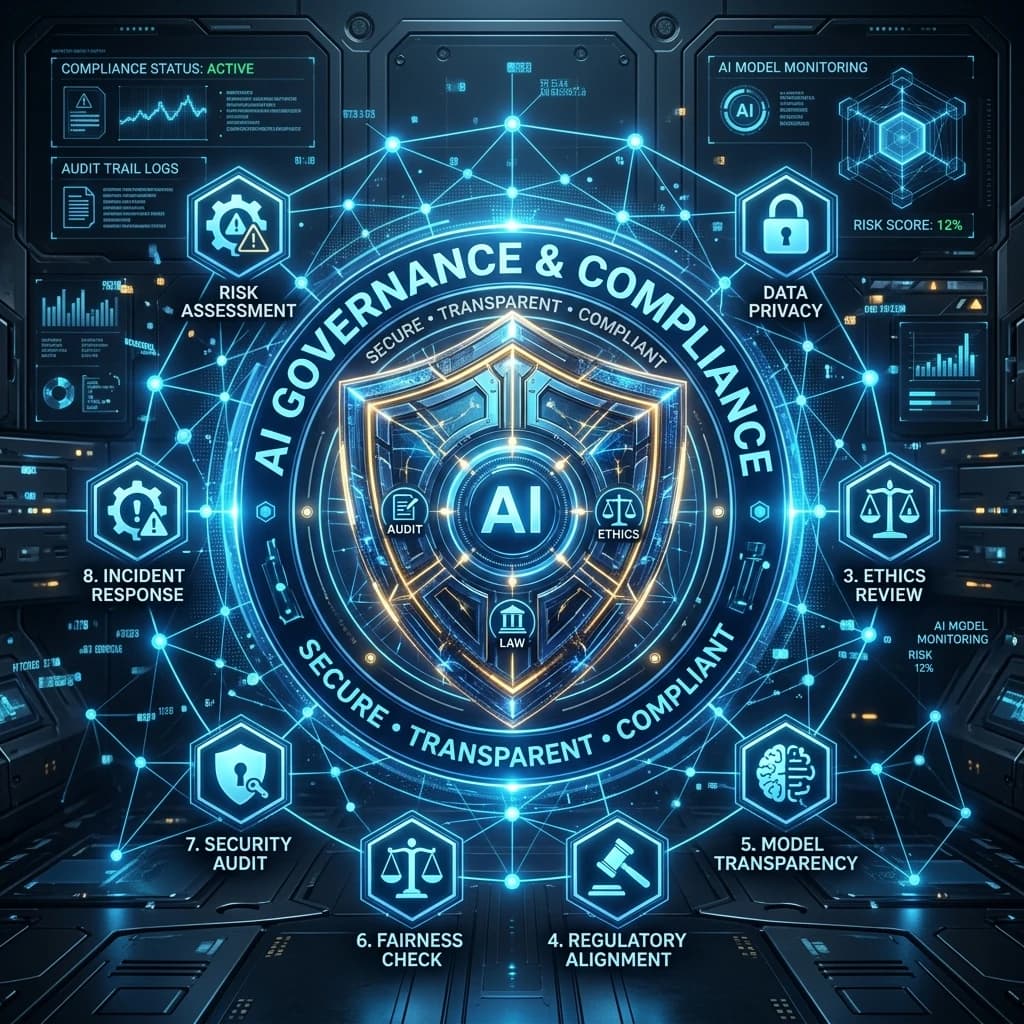
AI Governance Consulting for Responsible, Auditable Enterprise AI
Create the policies, accountability, risk controls, technical guardrails, and monitoring processes needed to develop and operate AI with greater confidence.
Mobiloitte helps organizations establish practical governance across machine learning models, generative AI applications, AI assistants, autonomous agents, third-party AI platforms, and automated decision systems.
From AI inventory and risk classification to lifecycle approvals, vendor assessments, human oversight, continuous monitoring, incident management, and executive reporting, we turn high-level responsible AI principles into controls that business and technical teams can apply consistently.
Begin with your current AI systems, vendors, data, policies, and decision workflows—not a generic governance template.
Complete AI Visibility
Create a central inventory of internally built, purchased, embedded, experimental, and employee-used AI systems.
Risk-Based Controls
Apply governance according to the use case, data, autonomy, affected users, potential impact, and operating environment.
Lifecycle Governance
Introduce approval, testing, deployment, monitoring, change, incident, and retirement controls throughout the AI lifecycle.
Executive Oversight
Give leadership a clear view of AI adoption, risk levels, control status, exceptions, incidents, and remediation.
Move From Responsible AI Principles to an Operating Governance Program
Many organizations have published AI principles but have not translated those principles into everyday processes.
A policy may state that AI should be fair, transparent, secure, and accountable. That statement alone does not tell teams which AI systems must be registered, who owns each system, what testing is required before deployment, or how AI incidents should be escalated.
Effective AI governance creates these answers.
Mobiloitte helps organizations connect leadership, legal, compliance, enterprise risk, security, privacy, data, procurement, product, engineering, operations, and business teams through one practical governance operating model.
Practical questions an operational governance program resolves:
What Is AI Governance?
AI governance is the system of policies, roles, decision rights, controls, assessments, documentation, and monitoring used to direct and oversee how an organization develops, purchases, deploys, and operates artificial intelligence.
AI Governance vs Related Disciplines
Responsible AI
Principles and ethical aspirations supporting accountable, transparent, fair, and reliable AI.
AI Governance
The operational structure, policies, decision rights, roles, and controls implementing Responsible AI principles.
AI Risk Management
Identifies, evaluates, mitigates, and reports risks associated with specific AI systems and models.
AI Compliance Readiness
Assesses whether legal, regulatory (NIST, ISO 42001, EU AI Act), and contractual requirements are met.
AI Assurance
Provides structured evidence that governance controls, testing, and monitoring meet formal expectations.
Signs Your Organization Needs Formal AI Governance
Common operational indicators that AI adoption is outpacing organizational oversight.
No Central AI Inventory
Business units use public tools, embedded vendor AI, custom apps, and agents without central visibility.
Implement an enterprise AI system registry covering built, bought, and experimental AI.
Governance Begins Too Late
Legal, privacy, security, or risk teams learn about an AI initiative shortly before launch.
Integrate AI risk screening into early product discovery and procurement intake.
Approval Processes Are Inconsistent
One AI project undergoes heavy review while another moves to production without assessment.
Establish standardized risk tiering and formal approval gates based on impact.
Third-Party AI Treated Like Normal Software
Standard vendor reviews fail to evaluate model bias, training data, output risk, or autonomy.
Deploy AI-specific vendor due diligence covering data retention and model updates.
Policies Are Too General
Statements like 'AI should be ethical' provide no concrete guidance for engineers or product owners.
Draft operational policies defining acceptable use, testing rules, and human review.
High-Impact Decisions Lack Oversight
No clear rules exist for when a human must review, override, or explain an AI outcome.
Design meaningful human-in-the-loop oversight for consequential decisions.
Generative AI Use Is Expanding Informally
Employees submit confidential IP to public AI tools or reuse unverified AI content.
Establish clear acceptable-use rules and provide secure, approved internal AI tools.
AI Agents Take Actions Without Authority
Agentic systems update records, communicate externally, or execute transactions without bounds.
Define least-privilege agent permissions, action thresholds, and emergency stops.
Monitoring Ends After Deployment
Model drift, hallucination rate, security threats, and cost changes go unmonitored post-launch.
Implement continuous AI observability, guardrails, and periodic control reviews.
Leadership Cannot See AI Risk Clearly
Executives receive project updates but lack an enterprise-wide view of AI risk and compliance.
Build executive AI risk dashboards tracking portfolio health, incidents, and exceptions.
AI Governance Maturity Model
Assess where your organization stands today and plan a structured path to operational governance.
Level 1: Ad Hoc
Decentralized AI use, no reliable inventory, inconsistent reviews, personal employee judgment.
Level 2: Defined
Responsible AI principles drafted, working group forming, selective review of high-risk projects.
Level 3: Operational
Central AI registry live, risk tiers defined, standardized approvals, documented roles & evidence.
Level 4: Measured
Governance KPIs tracked, control effectiveness reviewed, executive dashboards maintained.
Level 5: Adaptive
Automated controls, continuous monitoring, evolving policy aligned with strategy & regulations.
Our AI Governance Consulting Services
Comprehensive advisory and engineering services to establish an auditable, operational AI governance program.
AI Governance Maturity Assessment
Evaluate strategy, policies, roles, inventory, risk classification, vendor due diligence, and regulatory readiness.
AI Strategy & Operating Model Design
Structure board oversight, AI governance committee, CoE roles, review cadences, and approval authorities.
AI System Inventory & Registry
Establish a central inventory of internal, vendor, embedded, experimental, and shadow AI systems.
AI Use-Case Intake & Approval
Design structured proposal workflows routing AI projects by risk, data sensitivity, and required reviewers.
AI Risk Classification & Tiering
Categorize AI by impact (Low, Moderate, High, Prohibited) based on data, autonomy, and user impact.
AI Impact Assessments (AIIA)
Deep evaluation of purpose, data quality, privacy, fairness, accuracy, security, and human oversight.
Responsible AI Policy Development
Draft enterprise AI policies, acceptable-use rules, GenAI guidelines, vendor standards, and agent rules.
NIST AI RMF Enablement
Operationalize the NIST AI Risk Management Framework across Governance, Map, Measure, and Manage functions.
ISO/IEC 42001 Readiness
Prepare policies, management reviews, documentation, and operational controls for AI management systems.
Regulatory & Standards Mapping
Map controls to NIST, ISO 42001, EU AI Act, U.S. state laws, NYC LL144, FTC guidance, and sector rules.
Generative AI Governance
Controls for prompt logging, RAG sources, hallucination management, IP, content disclosure, and human approval.
Agentic AI Governance
Permission boundaries, transaction caps, action logs, human override thresholds, and emergency stops.
Shadow AI Discovery & Remediation
Identify unapproved AI tools, browser extensions, and SaaS features while providing safe alternatives.
Third-Party AI Vendor Risk Assessment
Evaluate vendor model data retention, training privacy, accuracy, sub-processors, and IP terms.
AI Data Governance Integration
Align AI with data lineage, classification, consent, purpose limitation, synthetic data, and retention.
AI Evidence & Documentation
Create version-controlled system cards, model cards, data sheets, test reports, and audit trails.
AI Testing, EVAL & Validation
Governance requirements for accuracy, hallucination, prompt injection, bias, robustness, and performance.
AI Security & Red Teaming
Assess AI-specific security risks including prompt injection, data leakage, and unauthorized tool calls.
Human Oversight Design
Define mandatory review conditions, confidence thresholds, override authority, and reviewer training.
AI Control Dashboards & Observability
Portfolio dashboards tracking AI inventory, control gaps, drift, security events, and executive KPIs.
AI Incident Management
Establish incident severity tiers, escalation paths, containment runbooks, and root-cause reviews.
AI Literacy & Training
Design role-based training for executives, product managers, engineers, legal, procurement, and auditors.
Turn Responsible AI Principles Into Testable Controls
Accountability
Named business and technical ownership, decision rights, and executive escalation.
Transparency
System cards, model cards, user disclosures, and clear decision documentation.
Security & Privacy
Data classification, role-based access, encryption, secrets management, and retention.
Fairness & Harm Prevention
Impact assessments, bias evaluation, representative testing, and human review.
Reliability
Evaluation datasets, performance thresholds, drift monitoring, and change validation.
Human Agency
Meaningful human review, override rights, escalation, and appeal pathways.
Govern AI From Idea to Retirement
Tailored Governance by AI System Type
Predictive Machine Learning
Data quality, model performance thresholds, fairness, explainability, drift, and outcome monitoring.
Generative AI & RAG
Approved data providers, hallucination controls, knowledge grounding, content verification, and disclosure.
Autonomous AI Agents
Tool permissions, transaction authority caps, action logs, human approval thresholds, and emergency stops.
AI Governance by Industry
Tailored governance frameworks aligned with sector-specific risks and regulations.
Financial Services & FinTech
Credit/risk model validation, fraud systems, explainability, model risk management, and retention.
Healthcare & Life Sciences
Patient privacy, clinical support boundaries, model validation, professional oversight, and safety.
Human Resources
Recruitment tools, candidate screening, performance analysis, bias evaluation, and notice.
Retail & Commerce
Recommendation engines, dynamic pricing, marketing content verification, and fraud detection.
SaaS & Technology Platforms
Embedded AI features, customer data privacy, model provider due diligence, and agent permissions.
Government & Public Sector
Public impact assessments, procurement transparency, accessibility, human review, and auditability.
Our 14-Step AI Governance Process
A practical path to move your organization from initial visibility to continuous oversight.
Establish Scope
Define business units, AI types, and geographies.
Discover Portfolio
Identify registered, vendor, embedded, and shadow AI.
Assess Maturity
Review current policies, roles, controls, and reporting.
Define Risk Tiers
Establish classification matrix and review triggers.
Operating Model
Structure governance committee, CoE, and decision rights.
Draft Policies
Create clear rules for employees, developers, and vendors.
Registry & Intake
Implement central AI inventory and proposal workflows.
Lifecycle Controls
Define testing, security, oversight, and monitoring rules.
Map Frameworks
Align controls to NIST AI RMF, ISO 42001, and state laws.
Pilot Governance
Apply operating model to selected real AI projects.
Dashboards
Create operational, executive, and board risk reporting.
Role Training
Provide targeted training for executives, PMs, and devs.
Test Effectiveness
Review control operation and evidence completeness.
Continuous Tuning
Update governance based on incidents, laws, and tech.
Delivery Tiers & Engagement Options
Baseline Assessment
Current-state maturity evaluation, inventory sample, gap register, priority roadmap, and executive briefing.
Inventory & Shadow AI
Discovery methodology, complete AI inventory, ownership gap analysis, shadow AI findings, and remediation.
NIST RMF / ISO 42001
Framework alignment, profile mapping, control evidence models, gap assessment, and audit preparation.
Enterprise Program
Full operating model, registry software setup, intake workflows, GRC integration, dashboards, and role training.
10 Key Business Benefits
Measurable operational advantages delivered by an auditable AI governance program.
Faster AI Approval
Fast-track low-risk AI projects with pre-approved controls.
Greater AI Visibility
Give leadership full clarity on where AI is used and owned.
Reduced Shadow AI
Give employees clear rules, approved tools, and safe paths.
Stronger Vendor Decisions
Evaluate AI providers using consistent technical & privacy criteria.
Better Audit Readiness
Maintain version-controlled evidence rather than scrambling post-incident.
Safer AI Agents
Limit agent tool permissions, transactions, and autonomy.
Consistent Testing
Apply risk-based testing standards across internal & vendor tools.
Executive Confidence
Present portfolio risk clearly to boards and executive sponsors.
Better Customer Trust
Answer customer privacy, security, and governance questions easily.
Scalable AI Adoption
Reuse governance patterns across products, teams, and regions.
Why Choose Mobiloitte for AI Governance Consulting?
Engineering-Connected
We connect policies directly to technical systems, data, and workflows.
Business-First Risk
Evaluate purpose, user impact, and data—not just the AI model name.
Full-Lifecycle Scope
Cover intake, design, testing, approval, monitoring, and retirement.
GenAI & Agentic Focus
Address prompts, RAG sources, tool calls, memory, and autonomy.
Framework-Flexible
Map controls to NIST AI RMF, ISO 42001, state laws, and internal rules.
Practical Templates
Usable system cards, impact assessments, and audit evidence.
Integrated with GRC
Work with existing risk, privacy, procurement, and security teams.
Phased Rollout
Begin with a maturity assessment or inventory pilot before expanding.
Executive Reporting
Translate complex technical risk into concise board dashboards.
Long-Term Enablement
Train internal teams and update controls as regulations evolve.
Find Out Where Your AI Governance Program Stands
Bring your current AI systems, vendor list, policies, or regulatory concerns to a focused assessment discussion.
Start with the AI your organization is already using before designing controls for systems that do not yet exist.
AI Governance Consulting FAQs
Common questions from Chief Risk Officers, CISOs, Legal Counsel, and Engineering VPs considering AI governance consulting.
What is AI governance consulting?
AI governance consulting helps an organization design and operationalize the roles, policies, controls, assessments, documentation, and monitoring used to oversee AI. The engagement may include maturity assessment, AI inventory, risk classification, policies, impact assessments, lifecycle controls, vendor reviews, dashboards, training, and implementation support.
Why does an organization need AI governance?
Organizations need AI governance when AI use expands across teams, vendors, data, products, and business decisions. Without governance, ownership, risk assessment, testing, approval, monitoring, and incident response may become inconsistent.
Is AI governance only about regulatory compliance?
No. Regulatory readiness is one part of governance. Governance also helps organizations approve AI more consistently, manage risk, improve visibility, evaluate vendors, protect data, and scale successful systems.
What is the difference between AI governance and AI compliance?
AI governance is the wider system of accountability, decision-making, controls, and oversight. Compliance focuses on demonstrating that particular obligations have been addressed. A strong governance program can make compliance evidence easier to produce, but governance and compliance are not identical.
What is the NIST AI Risk Management Framework?
The NIST AI RMF is a voluntary risk-management framework intended to help organizations manage AI risks and support trustworthy AI. Mobiloitte can help translate the framework into organizational roles, controls, assessments, evidence, and reporting.
Does NIST certify organizations against the AI RMF?
The AI RMF should not be presented as a NIST certification. Organizations may use it to structure and improve their AI risk-management practices.
What is ISO/IEC 42001?
ISO/IEC 42001 is an international standard for establishing, implementing, maintaining, and improving an AI management system. Consulting may support readiness, but formal certification must be completed through an appropriately accredited certification process.
What belongs in an AI inventory?
An AI inventory may include the system, purpose, owner, vendor, model, data, users, decisions, autonomy, integrations, deployment, geography, risk tier, approval, monitoring, and review status.
What is shadow AI?
Shadow AI refers to AI tools, features, models, or workflows used outside approved organizational processes. Examples may include public AI tools, browser extensions, department subscriptions, embedded SaaS features, and unregistered prototypes.
How should generative AI be governed?
Generative AI governance may address approved providers, permitted data, retrieval sources, hallucination risk, content verification, disclosure, intellectual property, human review, logging, retention, and monitoring.
How is agentic AI governance different?
AI agents may take actions through tools and connected systems. They require controls for permissions, transaction limits, approvals, memory, action logs, external communication, failure handling, and emergency disablement.
What is an AI impact assessment?
An AI impact assessment evaluates the intended use, affected people, data, risk, potential harm, accuracy, fairness, security, oversight, monitoring, and residual risk of an AI system.
Who should own AI governance?
AI governance is usually shared across executive leadership, business owners, technical owners, legal, compliance, risk, privacy, security, data, procurement, and internal audit. A governance committee can coordinate these responsibilities.
How are third-party AI vendors assessed?
AI-specific vendor assessment may cover data use, model limitations, security, privacy, accuracy, bias, monitoring, incident notification, model changes, contractual terms, auditability, and exit options.
Can AI governance be added to existing systems?
Yes. Governance can be applied to AI systems that are already deployed, although additional remediation may be required if ownership, documentation, testing, or monitoring is missing.
How is AI governance monitored after launch?
Monitoring may include performance, drift, harmful output, security events, guardrail triggers, user complaints, human overrides, vendor changes, data quality, and policy exceptions.
What should an AI governance dashboard include?
A dashboard can show the AI inventory, risk tiers, ownership, assessment status, control gaps, incidents, remediation, monitoring status, vendor exposure, and executive decisions required.
How long does an AI governance engagement take?
The timeline depends on organizational size, AI portfolio, maturity, jurisdictions, policies, technology, documentation, and implementation scope. A focused assessment is shorter than an enterprise-wide implementation.
How much does AI governance consulting cost?
Cost depends on inventory size, business units, risk exposure, frameworks, policies, assessments, GRC integration, dashboards, training, and ongoing support. A maturity assessment provides a more reliable basis for estimation.
Can AI governance be implemented in phases?
Yes. A phased program may begin with inventory, ownership, risk tiers, and acceptable-use policies, followed by lifecycle controls, monitoring, training, and broader implementation.
Does AI governance guarantee legal compliance?
No consulting service or technology should make a universal guarantee of legal compliance. Governance can support readiness, risk management, documentation, controls, and evidence. Legal interpretation should be handled by qualified counsel.
Connect With Us About AI Governance
Discuss how our AI governance advisors and engineering teams can help you create a responsible, auditable, and scalable AI governance program.