

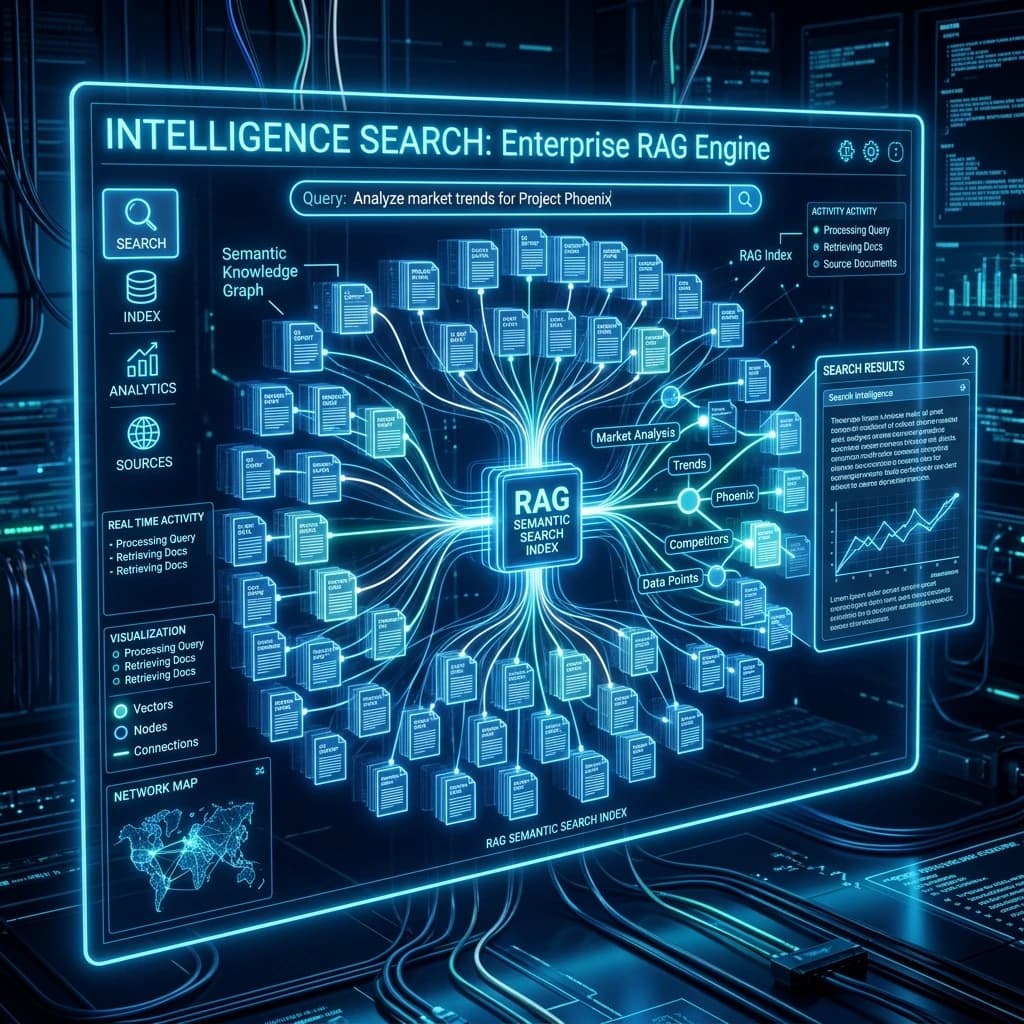
Enterprise RAG and Generative AI Search for Trusted Business Knowledge
Turn documents, applications, databases, policies, support records, and operational knowledge into secure AI-powered search and question-answering experiences.
Mobiloitte designs and develops enterprise search platforms, retrieval-augmented generation applications, knowledge assistants, multimodal document pipelines, hybrid retrieval systems, and agentic RAG workflows grounded in your approved business information.
Users can search across fragmented knowledge, ask questions in natural language, inspect supporting sources, and receive answers controlled by their existing roles and permissions.
Start with one knowledge-intensive workflow, a defined user group, and the sources they currently search manually.
Grounded Answers
Generate responses from approved enterprise sources instead of relying only on a model’s general training data.
Permission-Aware Search
Return documents and answers according to the user’s identity, role, group, tenant, and source-system permissions.
Traceable Sources
Include citations, document metadata, page references, and supporting passages where the source format allows.
Production Architecture
Design ingestion, retrieval, evaluation, monitoring, security, and deployment as one connected system.
Move From Scattered Knowledge to Context-Rich Enterprise Answers
Enterprise knowledge is rarely stored in one place. It may be distributed across:
- SharePoint & OneDrive
- Google Drive & M365
- Confluence & Jira
- Slack & MS Teams
- CRM & ERP platforms
- Zendesk & ServiceNow
- Contracts & Policies
- Databases & Warehouses
- Scanned PDFs & Diagrams
Traditional keyword search can return large lists of documents without directly answering the question. A standalone large language model may produce fluent answers but cannot reliably know the organization’s private, current, or permission-controlled information.
Retrieval-augmented generation connects these capabilities by retrieving relevant context from enterprise sources and supplying that context to a language model before generating a response.
Mobiloitte helps organizations build this complete knowledge-to-answer system with approved sources, permission filtering, reranking, source citations, human oversight, and production evaluation.
Search, Vector Search, RAG and Agentic RAG Patterns
Traditional Keyword Search
Matches exact terms or related text in indexed content. Best for product names, contract numbers, exact phrases, and technical identifiers.
Semantic or Vector Search
Retrieves information according to meaning rather than exact wording. Best for conceptual questions, natural-language requests, and queries using alternate terminology.
3. Hybrid Search & Reranking
Combines lexical and semantic retrieval. Best when a query requires both exact identifiers and contextual understanding (e.g., document ID + operational query intent).
Retrieval-Augmented Generation (RAG)
Retrieves context and uses a generative model to formulate a grounded answer. Best for question answering, summarization, policy interpretation, and research.
Agentic RAG
Extends retrieval with planning, multi-step search, tool use, and approved actions. An agentic RAG system can reformulate questions, search multiple systems, compare evidence, call approved APIs, and create tasks after human approval.
Enterprise RAG Maturity Model
Scale your knowledge platform from basic document chat to a fully governed, agentic knowledge engine.
Document Chat Prototype
Basic text extraction, vector-only retrieval, chatbot interface, manual document updates.
Department Assistant
Multiple content sources, metadata filters, user authentication, basic citations, scheduled ingestion.
Enterprise Search & RAG
Cross-app indexing, hybrid search, permission sync, reranking, source governance, production monitoring.
Multimodal & Adaptive
Text, tables, images, query classification, dynamic retrieval, model routing, cost optimization.
Governed Agentic Platform
Multi-step retrieval, approved tool access, human-approval thresholds, action audit logs, continuous evaluation.
Our Generative AI, RAG and Enterprise Search Services
End-to-end capabilities from discovery, connectors, and intelligent document processing to security, evaluation, and operations.
RAG Strategy & Readiness Assessment
We assess use-case suitability, knowledge source quality, security requirements, architecture options, and deliver an implementation roadmap.
Enterprise Search Development
Unified search across documents, applications, databases, and custom platforms with hybrid retrieval, metadata filtering, and personalization.
Custom RAG Application Development
Build knowledge assistants, policy copilots, technical documentation search, sales knowledge tools, and legal research platforms.
Knowledge Source Integration & Ingestion
Connectors for SharePoint, Google Workspace, Confluence, Jira, Salesforce, ServiceNow, GitHub, databases, object storage, and custom APIs.
Intelligent Document Processing (IDP)
Extract text, tables, charts, forms, scanned PDFs, reading order, and document hierarchies for high-accuracy retrieval.
Hybrid Search, Reranking & Vector DBs
Combine keyword and vector search with cross-encoder reranking, metadata filtering, and domain-tailored embedding models.
Permission-Aware & Secure RAG
Enforce document-level, row-level, and group-level access controls before context is sent to the model, preventing data exposure.
Agentic RAG & MCP Tool Integration
Develop multi-step retrieval agents connected to approved APIs, Model Context Protocol components, and human approval checkpoints.
RAG Evaluation, Observability & Tuning
Continuous evaluation of retrieval precision, answer faithfulness, citation accuracy, latency, token costs, and search analytics.
Managed RAG Operations & Modernization
Fix failing RAG prototypes, modernize vector-only systems, monitor pipeline health, and maintain connector synchronization.
Technology Ecosystem
We design open, vendor-flexible architectures across leading search engines, vector databases, frameworks, and model providers.
Search Platforms
Elasticsearch, Azure AI Search, OpenSearch, Solr, Vespa
Vector Databases
Pinecone, Weaviate, Milvus, Qdrant, pgvector, Chroma
Frameworks
LangChain, LangGraph, LlamaIndex, Semantic Kernel, Haystack
Models & Providers
OpenAI, Azure, Anthropic, Google, AWS, Cohere, Open-Source
Generative AI, RAG and Enterprise Search FAQs
Common questions regarding enterprise RAG architecture, vector search, permission controls, costs, and evaluation.
What is Retrieval-Augmented Generation (RAG)?
Retrieval-augmented generation (RAG) is an AI architecture that retrieves relevant information from external enterprise sources (documents, databases, APIs) and provides it to a generative language model as context for generating grounded answers.
How is RAG different from a traditional enterprise search tool?
Traditional search returns a list of document links. RAG interprets natural language questions, retrieves relevant passages, and uses a generative model to synthesize a direct, contextual answer with supporting source citations.
How does RAG ensure data permissions and security?
A production RAG pipeline synchronizes with identity providers (SSO/Active Directory) and source system permissions. Context is filtered before it is provided to the model so users only see information they are authorized to view.
What is Agentic RAG?
Agentic RAG extends answer-only retrieval with multi-step reasoning, tool execution, multi-system queries, and automated workflow actions under human approval guardrails.
What sources can be integrated into an Enterprise RAG platform?
RAG platforms can connect with SharePoint, Google Drive, Confluence, Jira, Slack, Teams, Salesforce, ServiceNow, Zendesk, GitHub, SQL databases, cloud data warehouses, scanned PDFs, images, and custom APIs.
How do you evaluate and measure RAG answer quality?
We evaluate retrieval precision, recall, hit rate, MRR, answer faithfulness to context, citation correctness, refusal quality on missing data, response latency, and cost per query using automated benchmarking datasets.
How do you prevent prompt injection and data leaks in RAG?
We treat retrieved content as untrusted input, separate system instructions from retrieved text, enforce strict source allowlists, implement output guardrails, and enforce role-based access before context assembly.
What is Multimodal RAG?
Multimodal RAG enables systems to ingest, index, and retrieve information across text, scanned pages, tables, charts, diagrams, forms, and image content rather than plain text alone.
Turn Enterprise Knowledge Into Governed Answers
Share the knowledge-intensive workflow your team wants to improve, the sources involved, and the permission requirements. Mobiloitte will help you design a secure, production-ready RAG roadmap.
Tell Us About Your Enterprise RAG Use Case
Describe the documents, applications, users, and search challenges you want to address. Our AI team will review your requirements and recommend a clear next step.