

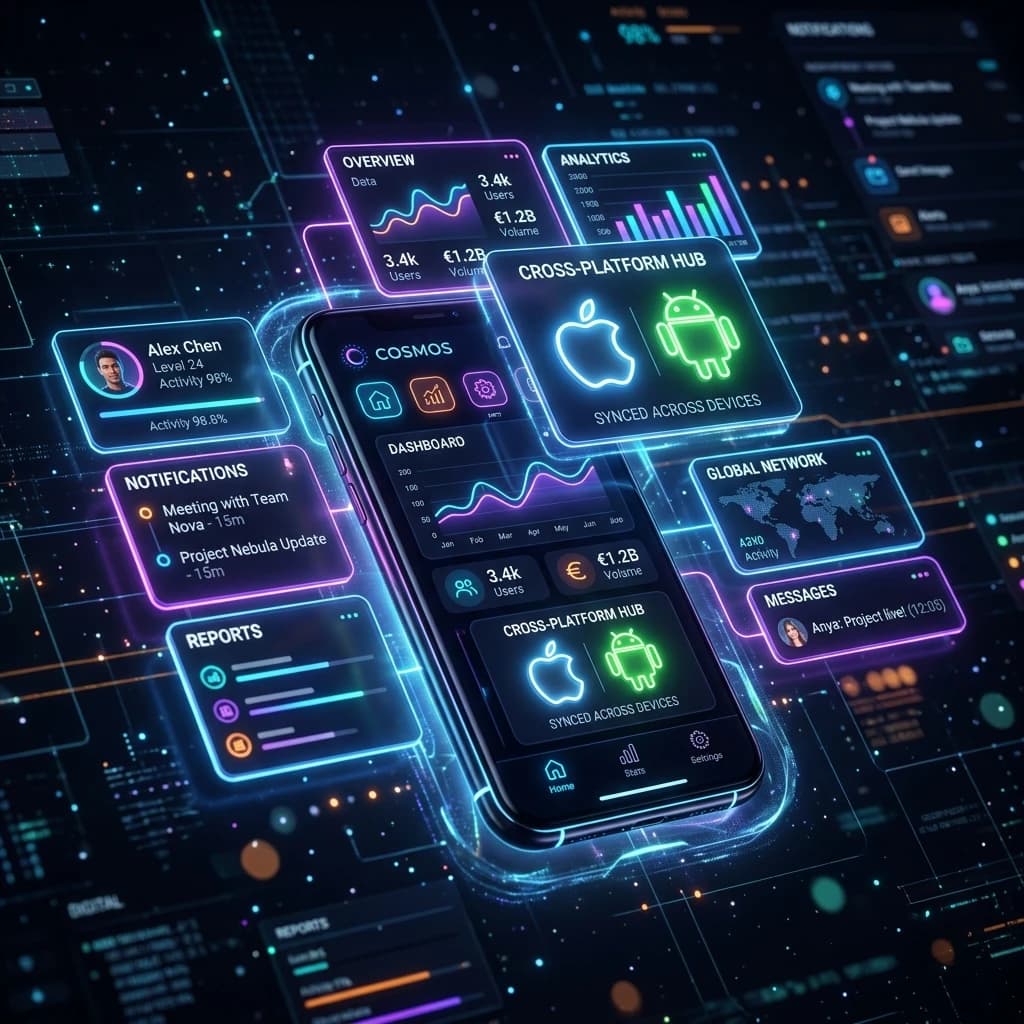
Custom Mobile App Development for iOS, Android, and Cross-Platform Products
Build a new mobile product, extend an existing business system, or modernize an outdated application through strategy, UX design, mobile engineering, backend development, integrations, quality assurance, app-store release, and post-launch support.
Mobiloitte develops customer-facing applications, enterprise mobility platforms, workforce tools, field-service apps, commerce products, subscription apps, internal operational systems, and AI-enabled mobile experiences.
Begin with your users, essential workflows, device requirements, existing systems, security needs, and the smallest valuable release.
Platform Strategy
Choose native iOS, native Android, Flutter, React Native, hybrid, or PWA according to the product—not a predetermined technology.
Mobile-First UX
Design around touch interactions, smaller screens, device capabilities, changing connectivity, and real mobile usage conditions.
Connected Architecture
Integrate mobile apps with APIs, cloud services, databases, CRM, ERP, payments, identity, analytics, and internal platforms.
Long-Term Reliability
Plan for testing, monitoring, app-store updates, OS changes, security updates, and continuous improvement.
Build a Mobile Application Around the User and the Business Workflow
A mobile application is not only a smaller version of a website. It operates across different screen sizes, OS versions, variable network conditions, offline environments, camera/GPS capabilities, and app-store policies.
Mobiloitte connects mobile frontend and backend components through one delivery model:
The objective is not simply to publish an app. It is to create a product that users can understand, trust, and continue using.
Native vs. Cross-Platform vs. Hybrid vs. PWA
Native iOS & Android
Swift/SwiftUI for iOS and Kotlin/Jetpack for Android. Best for premium platform-specific experiences, high performance, and deep device hardware integrations.
Cross-Platform (Flutter / React Native)
Single codebase targeting both iOS and Android. Best for faster multi-platform launches, shared business logic, consistent UI, and efficient maintenance.
Hybrid Mobile Apps
Web technologies inside a native container. Best for simpler internal tools, content-heavy apps, and teams reusing existing web engineering capabilities.
Progressive Web Apps (PWA)
Browser-delivered app experiences. Best for broad access without mandatory app-store downloads, offline caching, and push notifications.
When You Need Custom Mobile App Development
Identify where field operations, customer expectations, or outdated software limit mobile execution.
Field Paper Forms
Inspections, signatures, work orders, site updates, and evidence are collected manually on paper.
Lack of Deskless Access
Field and mobile teams lack secure access to schedules, customers, inventory, documents, or tasks away from desks.
System Silos & Duplicate Entry
Employees repeatedly enter the same customer, order, inspection, or job information into multiple systems.
Off-the-Shelf Mismatch
Packaged mobile applications force teams into rigid workflows that create delays and extra steps.
Outdated Current App
The existing mobile app has old frameworks, weak performance, low store ratings, or crashes frequently.
Unreliable Offline Behavior
Mobile teams lose work or experience app failure when cell connectivity becomes weak or unavailable.
Inconsistent Platform UX
iOS and Android versions behave differently or release core features at completely different times.
Strict Mobile Security Needs
Apps handling business, financial, health, location, or customer data need stronger mobile controls.
Manual Release Bottlenecks
Each release involves repetitive manual builds, signing, test distribution, and store submission friction.
AI Feature Integration
The mobile app needs intelligent search, document capture OCR, recommendations, voice, or AI assistants.
Our Mobile App Development Services
End-to-end engineering from platform strategy, UX design, and native/cross-platform development to store deployment and maintenance.
Mobile App Strategy & Discovery
Platform recommendation (iOS, Android, Flutter, React Native, PWA), user journey mapping, device feature review, offline requirements, and MVP scope definition.
Mobile UX & UI Design
Designing touch interactions, mobile navigation, wireframes, interactive prototypes, native HIG & Material Design compliance, and responsive screen adaptation.
iOS App Development
Native Swift and SwiftUI engineering for iPhone and iPad with Face ID, Apple Pay, camera capture, background processing, and App Store submission.
Android App Development
Native Kotlin and Jetpack Compose engineering for Android phones and tablets with biometrics, Google Pay, location services, and Google Play submission.
Cross-Platform Development (Flutter & React Native)
Shared codebase engineering for iOS and Android with high performance, consistent UI components, fast feature parity, and reduced maintenance costs.
Workforce & Field-Service Mobile Apps
Work orders, route support, GPS mapping, barcode/QR scanning, photo evidence capture, e-signatures, offline forms, and background synchronization.
Offline-First Mobile Architecture
Local SQLite/WatermelonDB storage, cached reference data, offline forms, background queue synchronization, and conflict resolution rules.
Mobile Backend & API Integration
Developing REST/GraphQL APIs, microservices, push notification engines (FCM/APNs), cloud databases, and CRM/ERP integrations.
AI-Powered Mobile Apps & On-Device ML
Integrating in-app AI assistants, document OCR capture, voice interaction, image analysis, personalized recommendations, and on-device ML models.
App Store Deployment & Maintenance
App Store & Google Play submission, signing, beta distribution (TestFlight), crash monitoring (Sentry), OS update compatibility, and continuous evolution.
Technology Ecosystem
We leverage modern, industry-standard mobile frameworks, backend cloud services, and release pipelines.
Native iOS & Android
Swift, SwiftUI, UIKit, Kotlin, Jetpack Compose, Java
Cross-Platform
Flutter, React Native, Ionic, Capacitor, PWA, Service Workers
Backend & Cloud
Node.js, Python, Java, AWS, Azure, GCP, Firebase, PostgreSQL
DevOps & Release
Fastlane, TestFlight, Google Play Console, GitHub Actions, Sentry
Mobile App Development FAQs
Common questions regarding iOS, Android, cross-platform apps, offline support, store deployment, and costs.
What are mobile app development services?
Mobile app development services cover strategy, UX design, frontend development, backend services, APIs, testing, deployment, and ongoing support for mobile applications.
What types of mobile apps can Mobiloitte build?
Potential applications include iOS apps, Android apps, cross-platform apps, enterprise mobility tools, field-service apps, customer apps, commerce apps, MVPs, PWAs, and AI-enabled mobile products.
Should we choose native or cross-platform development?
Native development may be better for deep platform capabilities or high-performance experiences. Cross-platform development (Flutter/React Native) may be better when shared functionality, time, and maintenance efficiency are priorities.
What is the difference between cross-platform and hybrid development?
Cross-platform frameworks produce native components using shared code. Hybrid applications run web technologies inside a mobile container.
What is a progressive web app (PWA)?
A PWA is a web application that provides installable, offline, caching, and notification capabilities through supported browsers.
Can Mobiloitte develop an iOS-only or Android-only application?
Yes. We build native iOS apps (Swift/SwiftUI) and native Android apps (Kotlin/Jetpack) tailored for specific device platforms.
Can one application run on both iOS and Android?
Yes. Flutter, React Native, and cross-platform frameworks allow a shared codebase to target both iOS and Android devices efficiently.
Can you build a mobile MVP?
Yes. A mobile MVP can focus on one target user group, one primary journey, essential backend services, required integrations, analytics, and a production release.
Can the app work without an internet connection?
Selected workflows can be designed for offline operation using local data storage, background synchronization, retries, and conflict management.
Can a mobile app integrate with our CRM or ERP?
Yes, subject to available APIs, access methods, permissions, data quality, and system constraints.
Can you integrate payments and subscriptions?
Yes. Payment gateways, digital wallets, in-app purchases, subscription billing, and entitlement management can be integrated according to platform rules.
Can the app use location, camera, or biometrics?
Yes. We integrate device GPS location, cameras for document/barcode scanning, and Face ID / Touch ID / Fingerprint biometric authentication.
Can you add AI features to a mobile application?
Yes. Potential features include AI assistants, intelligent search, document processing, recommendations, image analysis, summarization, and on-device ML.
How do you secure mobile applications?
Security may include strong authentication, authorization, secure local storage, encrypted communication, API protection, logging, and mobile-security testing.
Do you publish apps to the Apple App Store and Google Play?
Yes. Mobiloitte supports build preparation, signing, store listings, test distribution, submission, and release management.
Who owns the mobile app source code?
Ownership is explicitly defined in the commercial agreement, including source code, repositories, cloud accounts, store accounts, credentials, and documentation.
How long does mobile app development take?
The timeline depends on platforms, workflows, UX, backend, integrations, security, offline features, testing, and store preparation.
How much does mobile app development cost?
Cost depends on platform strategy, scope, design, backend, integrations, AI, offline support, testing, security, deployment, and maintenance.
Build a Mobile Application Your Users Can Rely On
Tell us what mobile app you want to build, which users it will support, how the current process works, and which systems it needs to connect. Mobiloitte will help determine whether native iOS, native Android, Flutter, React Native, or PWA is the right choice.
Tell Us About Your Mobile App Requirement
Describe your target users, device requirements, primary workflows, and existing applications. Our mobile architects will review your requirement and recommend a clear next step.