

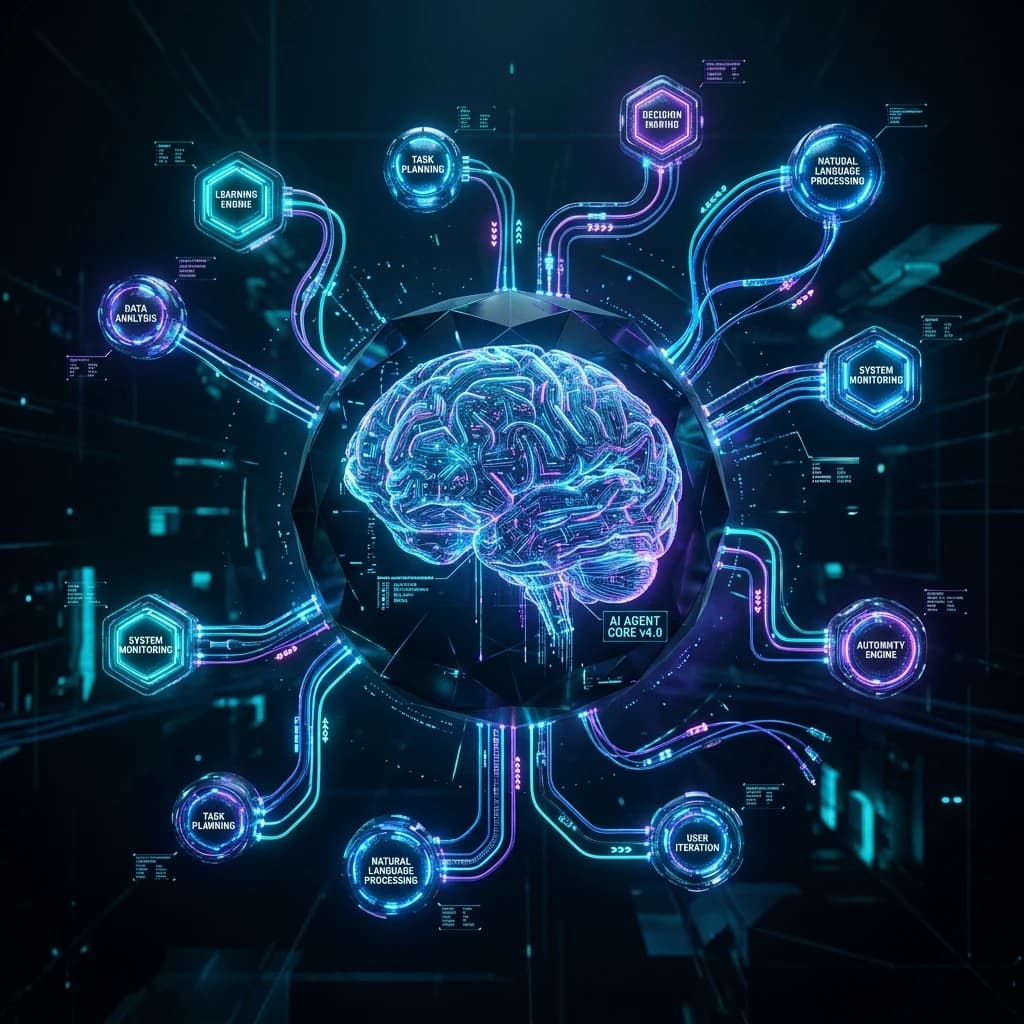
AI Agent Development Services for Enterprise Workflows
Build secure, context-aware AI agents that can reason through business situations, retrieve trusted information, use approved tools, and complete multi-step workflows across your enterprise systems.
Mobiloitte designs and develops custom AI agents that work with your data, applications, APIs, and operating rules. From customer support and sales qualification to document review, reporting, system reconciliation, and internal operations, we help organizations turn repetitive processes into governed agentic workflows.
Our AI agent development services cover strategy, architecture, model integration, retrieval-augmented generation, tool connections, guardrails, testing, deployment, monitoring, and continuous optimization.
From focused proofs of concept to production-ready enterprise AI agent systems.
Context-Aware Reasoning
Connect agents with approved enterprise knowledge and real-time business data.
Secure Tool Execution
Control which systems, APIs, records, and actions each agent can access.
Human Oversight
Route sensitive, uncertain, or high-impact decisions to the appropriate person.
Observable Workflows
Track agent decisions, tool calls, responses, errors, costs, and completion status.
Move Beyond Basic Chatbots and Rigid Automation
Traditional chatbots are designed primarily to answer questions. Rule-based automation follows predefined instructions. AI agents go further by interpreting a goal, gathering context, selecting the next appropriate action, using connected tools, and adapting their workflow based on the results.
A custom AI agent may retrieve information from a knowledge base, check a customer record in a CRM, compare documents, update an internal system, create a service ticket, schedule a follow-up, and escalate an exception—all within one controlled workflow.
Mobiloitte helps U.S. businesses build AI agents around their actual processes rather than forcing their operations into a generic product. Every agent is designed around defined responsibilities, authorized data sources, permitted actions, escalation rules, and measurable business outcomes.
What Is AI Agent Development?
AI agent development is the process of designing, building, testing, deploying, and managing intelligent software systems that can pursue defined goals with a degree of autonomy.
An enterprise AI agent typically combines:
The objective is not unrestricted autonomy. The objective is controlled intelligence that helps teams complete work faster while operating within clearly defined business and security boundaries.
When Your Business Needs Custom AI Agents
Identify where AI agents can streamline operations and remove manual friction.
Repetitive Work Consumes Specialist Time
Employees spend valuable hours reviewing similar documents, checking records, preparing reports, classifying requests, updating systems, and collecting information before they can make a decision.
AI agents complete repeatable preparation work while keeping judgment with specialists.
Employees Switch Between Too Many Systems
A single customer, finance, support, or operations request may require information from a CRM, ERP, ticketing system, spreadsheet, database, and internal knowledge base.
AI agents collect required context and coordinate actions across approved systems.
Internal Knowledge Is Difficult to Find
Policies, contracts, product information, process documents, and operational instructions are often distributed across multiple repositories.
Knowledge agents search approved sources and provide role-based answers.
Traditional Automation Breaks on Exceptions
Fixed automation performs well when every request follows the same path. It becomes difficult to maintain when inputs vary, contextual decisions are required, or workflows contain frequent exceptions.
AI agents interpret changing inputs while following business and escalation rules.
Customers Expect Faster Responses
Customers may need support outside normal operating hours or expect immediate answers about accounts, services, orders, applications, and appointments.
Customer-facing agents provide 24/7 assistance and escalate complex cases.
AI Experiments Are Not Ready for Production
Many organizations build promising prototypes that lack security controls, monitoring, integration reliability, evaluation processes, or clearly defined ownership.
Mobiloitte transforms prototypes into observable, production-ready systems.
Ready to evaluate custom AI agents for your workflows?
Our U.S. AI architects will assess your data sources, tool permissions, and task feasibility.
Schedule an AI Agent Discovery CallOur AI Agent Development Services
End-to-end capabilities from strategy and architecture to integration, testing, and continuous optimization.
AI Agent Consulting and Use-Case Discovery
We help your team identify where AI agents can create practical value without introducing unnecessary complexity.
Discovery Process Includes:
- Business workflow assessment
- Task identification
- Data & system readiness
- Integration feasibility
- Risk & compliance mapping
- Human approval rules
- Use-case prioritization
- Pilot & MVP scope planning
Result: Clear implementation roadmap connected to a specific operational problem.
Custom AI Agent Development
We design task-specific AI agents around your business processes, users, systems, data, and decision rules.
Custom Agents Can Be Developed To:
- Retrieve & analyze info
- Review & compare docs
- Answer employee questions
- Qualify & route leads
- Classify & prioritize requests
- Update system records
- Generate reports & summaries
- Escalate exceptions
Enterprise AI Agent Integration
An AI agent becomes useful when it can work with the systems your business already uses. We integrate agents with CRM, ERP, databases, APIs, support platforms, communication channels, BI tools, and custom enterprise apps.
Integration Controls Include:
Authentication, role-based permissions, input validation, action restrictions, logging, and retry logic.
Retrieval-Augmented Generation (RAG) & Knowledge Agents
We build RAG systems that allow AI agents to work with approved organizational knowledge instead of relying only on general model knowledge.
RAG Solution Capabilities:
Document ingestion, chunking, embeddings, vector/hybrid search, reranking, metadata filtering, source attribution, and access filtering.
AI Copilot Development
AI copilots assist employees inside their existing applications and workflows to find information, summarize records, draft responses, recommend next steps, and complete forms.
The employee remains in control while the copilot reduces preparation time and repetitive effort.
Multi-Agent System Development
Some workflows require several specialized agents rather than one general-purpose agent. We design multi-agent architectures containing planning, research, retrieval, execution, validation, review, routing, and monitoring agents.
Central orchestration coordinates responsibilities and prevents scope creep.
AI Agent Orchestration
We develop orchestration logic that controls how agents reason, call tools, exchange information, handle failures, request approvals, and complete tasks.
Features: Prompt chaining, conditional routing, tool selection, fallback behavior, and approval checkpoints.
AI Agent Modernization
Organizations that already have a chatbot, AI assistant, proof of concept, or early agent can engage Mobiloitte to improve its architecture, latency, cost control, guardrails, and production readiness.
Covers workflow redesign, model migration, prompt refinement, and cloud optimization.
AI Agent Testing and Evaluation
We evaluate task completion accuracy, response relevance, tool-selection precision, source grounding, hallucination risk, prompt-injection resistance, latency, and regression behavior using realistic business scenarios.
AI Agent Monitoring and Optimization
Production agents need continuous oversight. We help monitor reasoning paths, tool calls, human escalations, token costs, latency, user feedback, and policy adherence for continuous post-launch optimization.
Ready to Deploy AI Agents in Your Business?
Tell us about your manual workflows, connected tools, and operational goals. Our specialists will design an enterprise-ready roadmap.
AI Agent Capabilities We Build
Core technical and operational capabilities embedded into enterprise agentic architectures.
Goal-Based Task Execution
Agents interpret a defined objective, determine the required steps, and work through an approved sequence of actions.
Context-Aware Reasoning
Agents use conversation history, user information, workflow state, business rules, and enterprise data to understand each request.
Enterprise Search and Retrieval
Agents retrieve relevant information from approved documents, databases, knowledge bases, and connected systems.
Tool and API Usage
Agents call authorized tools and functions to retrieve information, update records, trigger actions, or coordinate workflows.
Memory and State Management
Agents maintain relevant context across conversations, workflow stages, and longer-running tasks while following retention and privacy requirements.
Multi-Step Workflow Coordination
Agents complete tasks that require several actions, systems, conditions, or approvals rather than producing only one response.
Human-in-the-Loop Controls
Agents pause, escalate, or request approval before completing sensitive or high-impact actions.
Role-Based Agent Behavior
Instructions, data access, permitted actions, and response behavior can be configured according to the user’s role or department.
Source-Aware Responses
Knowledge agents can identify the approved information used to prepare an answer and help users verify the response.
Exception Handling
Agents detect missing information, failed integrations, low-confidence results, policy conflicts, or unusual requests and route them appropriately.
Observability and Audit Trails
Teams can review workflow progress, tool usage, system actions, errors, approvals, and agent performance.
How an Enterprise AI Agent Works
Step-by-step workflow architecture from request triggering to recorded activity.
Understand the Request
The agent receives a request, event, document, message, or system trigger and identifies the intended objective.
Retrieve Relevant Context
It gathers permitted information from connected knowledge bases, databases, applications, and previous workflow steps.
Plan the Next Action
The agent evaluates the available context and chooses an action from its approved capabilities.
Use an Authorized Tool
It may query a database, call an API, search a knowledge source, prepare a document, update a record, or initiate another workflow.
Validate the Result
Rules, validation logic, and optional reviewer agents check whether the result is complete, grounded, properly formatted, and within policy.
Request Approval When Required
Sensitive actions are paused and sent to an authorized person for approval, modification, or rejection.
Complete or Escalate
The agent completes the permitted action or transfers the case to a human team with the relevant context already prepared.
Record the Activity
The system logs applicable inputs, decisions, actions, approvals, errors, costs, and outcomes for monitoring and improvement.
Types of AI Agents We Develop
Tailored agentic solutions built for specific functional and operational demands.
Customer Support Agents
Support customers by answering approved questions, retrieving account info, checking status, creating tickets, and escalating complex cases.
Sales Qualification Agents
Engage prospects, collect requirements, answer product questions, assess intent, enrich lead records, and schedule consultations.
Employee Knowledge Agents
Help employees find policies, process instructions, product documentation, technical information, and internal resources.
Document Processing Agents
Extract information, compare documents, identify missing fields, check content against business rules, and prepare structured summaries.
Operations Agents
Coordinate repeatable business processes, update systems, reconcile records, prepare status reports, and route exceptions.
Data Analysis Agents
Query approved business data, summarize findings, identify patterns, generate reports, and support decision-making.
Finance & Reconciliation Agents
Compare invoices, payments, transaction records, purchase info, and system entries while routing discrepancies for review.
IT Service Agents
Classify requests, retrieve technical resolution info, create tickets, collect diagnostic details, and automate support actions.
Scheduling & Coordination Agents
Check availability, collect meeting requirements, schedule appointments, send reminders, and update related systems.
Quality Assurance Agents
Review requirements, prepare test scenarios, check outputs, summarize defects, and support release-readiness workflows.
Research Agents
Collect information from approved sources, organize findings, compare options, and prepare structured research summaries.
Software Engineering Agents
Support code analysis, documentation, migration preparation, test generation, and issue investigation under engineering supervision.
AI Agent Use Cases Across Your Organization
Practical applications tailored for core business departments.
Customer Service
- Answer FAQs
- Retrieve order info
- Classify & route requests
- Create & update tickets
- Prepare recommended responses
- Escalate sensitive cases
- Summarize interaction history
Sales
- Qualify inbound leads
- Collect requirements
- Answer service/product Qs
- Update CRM records
- Schedule consultations
- Prepare pre-call summaries
- Trigger follow-up workflows
Marketing
- Analyze campaign data
- Prepare content briefs
- Summarize feedback
- Coordinate campaign workflows
- Organize market research
- Support lead nurturing
- Generate performance summaries
Human Resources
- Answer employee policy Qs
- Support onboarding
- Collect candidate info
- Summarize resumes
- Schedule interviews
- Prepare service requests
- Escalate confidential cases
Finance
- Review invoices & payments
- Identify discrepancies
- Extract financial doc info
- Prepare reconciliation summaries
- Route approval requests
- Answer internal finance Qs
- Generate recurring reports
Operations
- Coordinate cross-dept tasks
- Check data consistency
- Update workflow status
- Monitor pending actions
- Prepare management summaries
- Route exceptions
- Reduce manual handoffs
Information Technology
- Triage service requests
- Search technical docs
- Collect diagnostic details
- Create & update tickets
- Recommend resolution steps
- Monitor workflow status
- Escalate security requests
Industry-Specific AI Agent Development
Built to address specific regulatory, data security, and operational standards across key verticals.
Healthcare
Appointment assistance, patient-service navigation, document processing, and administrative support with human review controls.
Financial Services & FinTech
Customer assistance, application support, document collection, transaction research, and compliance workflows.
Real Estate & PropTech
Property discovery, lead qualification, CRM assistants, document review, and appointment coordination.
Retail & Commerce
Shopping assistants, customer support, catalog enrichment, order assistance, and inventory coordination.
Logistics & Supply Chain
Review shipment info, coordinate exceptions, retrieve operational data, prepare reports, and synchronize updates.
Education & EdTech
Admissions assistants, learner-support agents, course navigation, administrative tools, and instructor copilots.
SaaS & Tech Platforms
Embed agents into software products for onboarding, support, account navigation, and internal operations.
Professional Services
Research, document review, knowledge management, client-service, reporting, and workflow coordination.
Looking for industry-specific AI agent compliance?
Build secure AI agents tailored to Healthcare, FinTech, Real Estate, Retail, or Logistics governance standards.
Plan an Enterprise AI Agent PilotConnect AI Agents With Your Enterprise Ecosystem
Mobiloitte develops AI agents that interact with existing enterprise applications through secure APIs, approved connectors, databases, and custom integration layers.
CRM and Sales Systems
- • Salesforce
- • HubSpot
- • Microsoft Dynamics
- • Custom CRM platforms
ERP and Business Systems
- • SAP
- • NetSuite
- • Custom ERP systems
- • Internal operational platforms
Communication & Collaboration
- • Microsoft Teams
- • Slack
- • Email systems
- • Twilio communication workflows
Data and Knowledge Sources
- • Relational databases & Data Warehouses
- • Document repositories & Cloud storage
- • Internal knowledge bases
- • Custom Business APIs
Customer & Employee Apps
- • Web & Mobile Applications
- • Customer & Employee Portals
- • Administrative Dashboards
- • Internal Business Tools
Security Built Into the AI Agent Lifecycle
Designed across development, deployment, and runtime operations to safeguard sensitive data and critical systems.
Role-Based Access Control
Agents and users receive only the data and system permissions required for their assigned responsibilities.
Least-Privilege Tool Access
Every agent tool is limited to defined functions, resources, operations, and environments.
Identity & Authentication
Agent access is managed through approved authentication methods, credentials, tokens, and service identities.
Data Isolation
Data access is separated according to user, department, customer, region, business unit, or application role.
Input & Output Guardrails
Validation controls identify disallowed instructions, unsafe responses, unsupported actions, and data exposure.
Human Approval Gates
High-impact actions require confirmation from an authorized employee before execution.
Audit Logging
Requests, tool calls, approvals, system actions, errors, and outcomes are logged for investigation and governance.
Prompt-Injection Protection
Source restrictions, tool permission controls, instruction hierarchy, and action validation defend against attacks.
Sensitive Data Handling
PII, financial, and confidential data are governed through masking, filtering, access restrictions, and retention policies.
Environment Separation
Dev, testing, staging, and production environments are isolated to reduce unintended access.
Runtime Monitoring
Behavior is monitored for unusual tool usage, repeated failures, unauthorized actions, and workflow deviations.
Understand What Your AI Agents Are Doing
Production AI systems should not operate as black boxes. Mobiloitte implements observability that gives complete visibility into agent decisions and workflow status.
Complete Operational Tracing:
Our AI Agent Development Process
A structured 10-step lifecycle to move from initial discovery to production scale.
Discover Workflow
Identify business objective, users, current process, data sources, and risk level.
Define Responsibilities
Document what agent should and must not do, access rules, and human checkpoints.
Design Architecture
Select model strategy, orchestration pattern, RAG approach, and integration layer.
Prepare Data
Organize documents, APIs, databases, metadata, and access rules for reliable context.
Build Agent
Develop instructions, workflow logic, tools, retrieval components, and fallback behavior.
Apply Guardrails
Configure validation rules, permission boundaries, approval checkpoints, and audit logging.
Test Scenarios
Evaluate agent against expected requests, edge cases, integration failures, and injection attempts.
Launch Pilot
Deploy to a restricted environment or selected user group before full rollout.
Monitor Performance
Review task completion, errors, response quality, escalations, latency, and costs.
Optimize & Scale
Improve prompts, retrieval, integrations, and models before adding new use cases.
Start at the Right Level of Complexity
Flexible engagement options aligned to your organization's AI maturity.
AI Agent Discovery
Best for organizations that need to identify high-value use cases, evaluate readiness, and establish a roadmap.
Typical Deliverables:
- • Workflow assessment
- • Use-case prioritization
- • Feasibility analysis
- • Architecture recommendation
- • Pilot roadmap
Proof of Concept
Best for validating whether an agent can complete one clearly defined workflow using limited data and tools.
Typical Deliverables:
- • Focused use case
- • Initial model & prompt setup
- • Limited knowledge source
- • Tool connection demo
Minimum Viable Product
Best for deploying an agent to selected users with production architecture, access controls, and monitoring.
Typical Deliverables:
- • End-user interface
- • Core enterprise integrations
- • Retrieval & knowledge layer
- • Permission & approval controls
Production & Enterprise Scale
Best for expanding agents across teams, systems, locations, or customer journeys.
Typical Deliverables:
- • Scalable architecture
- • Multiple integrations
- • Advanced access control
- • Full observability & governance
Model-Agnostic and Integration-Focused Development
The best model and architecture depend on your workflow, privacy requirements, latency expectations, accuracy needs, operating cost, existing cloud environment, and integration landscape.
Mobiloitte selects technology according to the business requirement rather than forcing every project into one model, framework, or vendor ecosystem.
Technology & Framework Options:
Business Outcomes AI Agents Can Support
Measurable improvements delivered through governed agentic implementation.
Why Choose Mobiloitte for AI Agent Development?
Engineered for real-world enterprise adoption, governance, and business value.
Business-First Discovery
We begin with the operational problem and expected outcome—not with a predetermined AI tool.
End-to-End Engineering
Full-stack support across strategy, UX, architecture, data preparation, backend, cloud, testing, and monitoring.
Custom Enterprise Integration
We develop agents around your existing applications, APIs, data sources, and operating processes.
Governance From Beginning
Permissions, approval gates, auditability, privacy, and escalation paths are designed into the core architecture.
Human-Centered Automation
Agents support employees while keeping sensitive or high-impact decisions under appropriate human control.
Production-Oriented Delivery
Built with evaluation frameworks, integration reliability, exception handling, and security controls.
Phased Implementation
Validate value with a focused workflow before expanding gradually across the enterprise.
Long-Term Optimization
Continuous post-launch review and refinement as models, processes, and business requirements evolve.
Build a Connected Enterprise AI Strategy
Explore related AI capabilities and industry solutions to build a comprehensive digital roadmap.
AI Workflow Automation
Automate structured business processes, approvals, routing, and system coordination.
AI workflow automation servicesAI Assistants & Chatbots
Create conversational interfaces for customer service, employee support, and info access.
enterprise AI assistantsAI Voice Automation
Enable natural-language voice interactions for customer, sales, and service workflows.
AI voice automation solutionsCustom AI Software
Build AI-powered platforms and tailored features for your organization.
custom AI software developmentCRM & ERP Systems Integration
Connect applications, data, users, and workflows across your enterprise ecosystem.
enterprise systems integrationData Platforms & Dashboards
Prepare governed data foundations and operational visibility for AI workflows.
enterprise data platformsIndustry Solutions & Specialist Consultations:
AI Agent Development FAQs
Common questions regarding enterprise AI agents, security, costs, timelines, and integration capabilities.
What is an AI agent development company?
An AI agent development company designs and builds intelligent software agents that can understand objectives, retrieve information, use connected tools, complete approved tasks, and coordinate multi-step workflows. The company may also provide consulting, data preparation, integration, testing, security, deployment, monitoring, and ongoing optimization.
What is the difference between an AI agent and a chatbot?
A chatbot primarily responds to user questions. An AI agent can go beyond conversation by planning actions, using tools, retrieving system data, updating records, triggering workflows, and completing multi-step tasks within defined permissions.
What business processes can AI agents automate?
AI agents can support customer service, lead qualification, employee self-service, document processing, research, reporting, ticket routing, scheduling, data reconciliation, internal knowledge retrieval, system updates, and other repeatable workflows. The right use case is one with a clear objective, accessible data, defined actions, measurable outcomes, and appropriate human oversight.
Can AI agents connect with our CRM, ERP, and internal systems?
Yes. AI agents can be integrated with enterprise applications through APIs, databases, approved connectors, webhooks, and custom middleware. The integration design depends on the available system interfaces, authentication requirements, data sensitivity, and actions the agent is permitted to perform.
Can you build an AI agent using our company data?
Yes. We can develop retrieval and knowledge components that connect an agent with approved documents, databases, knowledge bases, and business systems. Access controls can be applied so users and agents only retrieve information they are authorized to use.
What is retrieval-augmented generation?
Retrieval-augmented generation allows an AI system to search approved information sources and use relevant content when preparing a response or completing a task. This helps the agent work with current organizational knowledge and can improve grounding, relevance, and source transparency.
What is a multi-agent system?
A multi-agent system uses several specialized agents that cooperate on a larger workflow. One agent may plan the task, another may retrieve information, another may execute actions, and another may validate the result. Multi-agent architecture is useful for certain complex workflows but is not required for every implementation.
Do AI agents make decisions without human involvement?
The level of autonomy is configurable. Low-risk actions may be completed automatically, while financial, legal, compliance-related, customer-impacting, or uncertain actions can require human approval.
How do you control what an AI agent can do?
Controls can include role-based access, least-privilege permissions, restricted tools, approved data sources, input validation, output guardrails, action limits, approval checkpoints, audit logs, and runtime monitoring.
How do you test an AI agent?
AI agent testing includes expected scenarios, edge cases, incomplete requests, tool failures, retrieval quality, hallucination risk, permission boundaries, prompt-injection attempts, human escalation, latency, costs, and regression testing.
How long does it take to develop an AI agent?
The timeline depends on workflow complexity, number of integrations, data readiness, security requirements, user experience, testing depth, and deployment environment. A focused proof of concept can be delivered faster than a production system that connects with multiple enterprise applications. After discovery, Mobiloitte provides a phased implementation plan and delivery estimate.
How much does AI agent development cost?
Cost depends on the selected use case, architecture, models, integrations, knowledge sources, interface requirements, security controls, expected usage, infrastructure, and ongoing monitoring needs. We recommend beginning with a clearly defined workflow so the scope, investment, and expected value can be evaluated accurately.
Can an existing chatbot be upgraded into an AI agent?
In many cases, yes. An existing chatbot can be enhanced with enterprise retrieval, memory, tool usage, workflow logic, system integrations, approval controls, monitoring, and more advanced user experiences. The existing architecture must first be reviewed to determine whether it should be extended, partially redesigned, or replaced.
Can AI agents operate across multiple communication channels?
Yes. Depending on the implementation, an agent can support websites, mobile applications, internal portals, messaging channels, collaboration tools, email, and voice interfaces while using a shared business logic and knowledge layer.
How do you prevent AI agents from exposing sensitive data?
Sensitive-data protection can include user authentication, role-based retrieval, data filtering, masking, tenant isolation, tool restrictions, prompt-injection defenses, output checks, audit logging, and human approval requirements.
What happens when an AI agent cannot complete a task?
The agent can request missing information, retry a permitted action, use a fallback workflow, create a support case, or escalate the task to an employee with the relevant context and completed steps attached.
Can AI agents be deployed in our cloud environment?
Deployment options depend on the models, data architecture, security requirements, and existing infrastructure. Agents can be designed for public cloud, private cloud, hybrid, or other controlled environments based on the project requirements.
How do we measure the success of an AI agent?
Success metrics may include task completion rate, processing time, escalation rate, tool accuracy, retrieval relevance, user satisfaction, error rate, cost per workflow, response time, and the amount of repetitive work reduced. The measurement framework should be defined before the pilot begins.
Turn a Repetitive Workflow Into a Governed AI Agent
Share the process your team wants to improve, the systems involved, and the actions that currently require manual effort. Mobiloitte will help you identify a focused starting point, define responsibilities and boundaries, and create a practical roadmap.
Tell Us About Your AI Agent Use Case
Describe the workflow, systems, users, and business challenge you want to address. Our team will review your requirements and recommend an appropriate next step.