

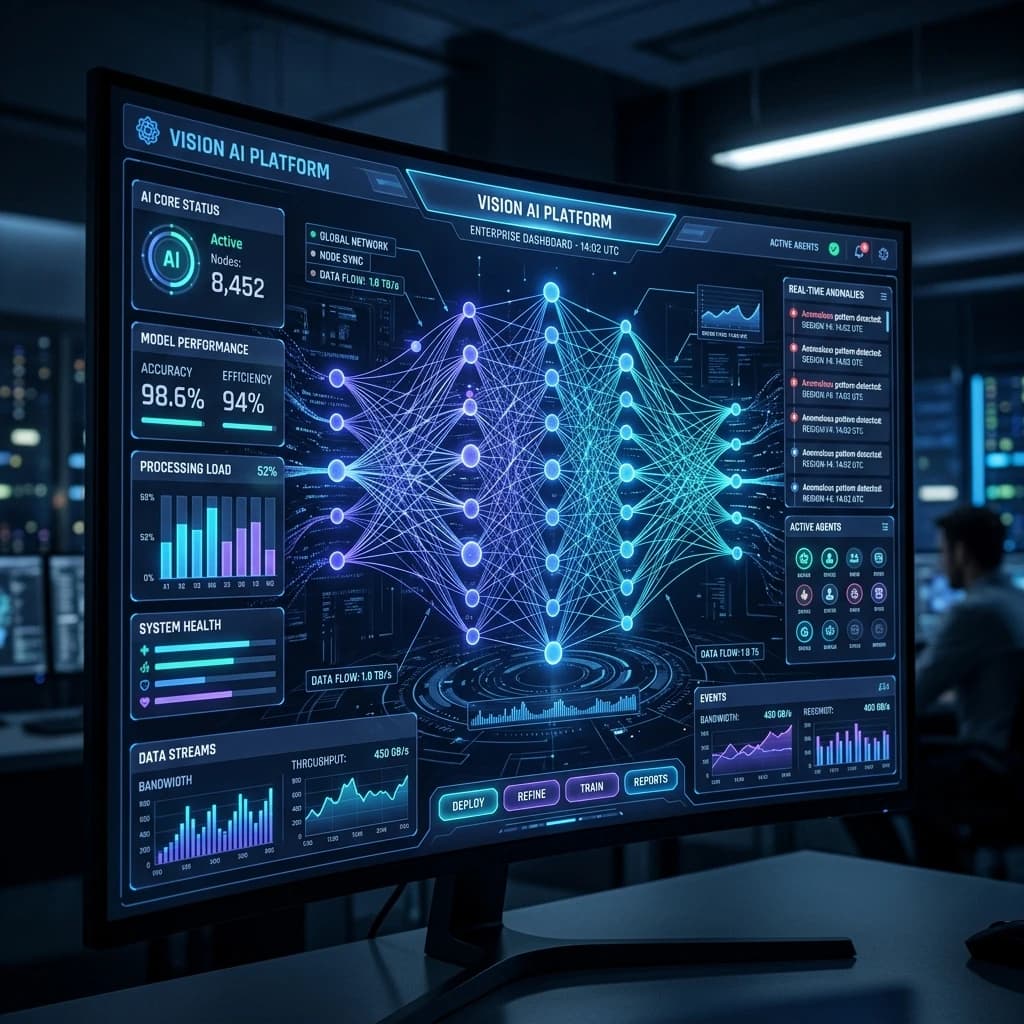
Custom AI Software Development Services Built Around Your Business
Turn proprietary data, specialized workflows, and high-value business decisions into secure, scalable AI software that your organization can own, operate, and improve.
Mobiloitte designs and develops custom AI applications, machine learning systems, generative AI products, predictive platforms, intelligent automation tools, and enterprise AI capabilities aligned with your users, data, systems, and operating requirements.
From feasibility assessment and proof of concept to production engineering, enterprise integration, deployment, monitoring, and continuous optimization, we help organizations move from an AI idea to software that performs reliably in real business environments.
⚡ Start with a focused business case, validate it with real data, and scale only after value is demonstrated.
Business-Aligned
Every solution begins with a defined problem, target user, measurable outcome, and operational requirement.
Data-Grounded
Build intelligence around your approved business data, documents, transactions, systems, and domain knowledge.
Production-Ready
Design for security, scalability, integration, monitoring, resilience, and long-term maintainability.
Built for Ownership
Receive a custom software asset aligned with your roadmap rather than a disconnected AI experiment.
Move Beyond Generic AI Tools and Isolated Experiments
Off-the-shelf AI tools can solve common problems quickly. They become less effective when your organization has specialized terminology, proprietary data, unique workflows, strict access requirements, complex integrations, or performance expectations that a general-purpose product cannot satisfy.
Custom AI software is developed around those differences.
It can analyze your information, automate a domain-specific process, predict an operational outcome, assist users, detect patterns, interpret documents, personalize experiences, or coordinate actions across business systems.
Mobiloitte combines artificial intelligence engineering with software product development, data engineering, enterprise integration, cloud architecture, security, user experience, testing, and operational support.
The result is not only an AI model. It is a usable software product that connects intelligence with people, data, workflows, applications, and measurable business outcomes.
What Is Custom AI Software Development?
Custom AI software development is the process of designing, building, testing, deploying, and maintaining artificial intelligence software created for a specific organization, product, workflow, or business problem.
Designed Around Your Context
- Proprietary business data
- Domain-specific terminology
- Existing applications and infrastructure
- Unique operational rules
- User roles and permissions
- Industry requirements
- Required accuracy and response time
- Private or controlled deployment
- Human approval requirements
- Audit and monitoring needs
- Long-term product ownership
Complete AI System Components
- Machine learning models
- Foundation & Large language models
- Retrieval-augmented generation (RAG)
- Predictive analytics
- Natural-language processing (NLP)
- Computer vision
- Recommendation engines
- AI agents and copilots
- Data pipelines
- APIs and backend services
- Web or mobile interfaces
- Cloud infrastructure
- Security controls
- Evaluation frameworks
- MLOps and LLMOps
- Monitoring & retraining workflows
When Does Custom AI Make More Sense?
Evaluate your use case, data privacy needs, and business differentiation to choose the right strategy.
Choose Off-the-Shelf AI When
- •The use case is common and standardized
- •Limited customization is required
- •Business data does not need deep integration
- •The organization wants immediate basic functionality
- •Existing vendor controls meet security requirements
- •The tool does not create a core competitive advantage
Choose Custom AI Software When
- The solution depends on proprietary data
- The workflow is specific to your business
- AI must connect with several enterprise systems
- Output quality must be evaluated against custom rules
- Users require a tailored interface or experience
- Access varies by user, role, customer, or department
- The solution must operate inside your environment
- Auditability or human approval is required
- AI capability is part of your product differentiation
- Your organization needs control over the roadmap
Choose a Hybrid Approach When
A custom application can also use proven commercial or open-source AI models while adding your own data, orchestration, user experience, controls, integrations, and evaluation.
Custom development does not always require training a new foundation model. The correct architecture depends on the problem, data, quality requirements, cost, privacy, and scale.
Do You Need AI Development, AI Integration, or Modernization?
We align our engagement model with your software maturity, existing systems, and long-term product vision.
Net-New AI Product Development
Choose this when the product is being designed around AI from the beginning.
- ✓A new AI-powered SaaS platform
- ✓A predictive analytics product
- ✓An intelligent document-processing system
- ✓A recommendation platform
- ✓A custom research application
- ✓An AI copilot
- ✓A computer vision product
- ✓An agentic workflow system
AI Integration Into Existing Software
Choose this when you already have a working application and want to add a specific AI capability.
- ✓Adding an AI assistant to a customer portal
- ✓Adding document extraction to a workflow
- ✓Adding recommendations to an e-commerce platform
- ✓Adding prediction to an operational dashboard
- ✓Adding summarization to a CRM platform
- ✓Adding an AI agent to an internal application
AI Software Modernization
Choose this when you already have an AI prototype, model, chatbot, or application that is not production-ready.
- ✓Replacing fragile prototype code
- ✓Improving model accuracy & retrieval quality
- ✓Redesigning data pipelines
- ✓Reducing latency or inference costs
- ✓Adding security and access controls
- ✓Introducing monitoring and MLOps
- ✓Migrating models or cloud services
- ✓Adding a scalable backend & responsive UI
When Your Organization Needs Custom AI Software
We help business leaders solve core operational hurdles where standard off-the-shelf software falls short.
Generic AI Does Not Understand Your Business
General-purpose models fail on specific terminology, operational rules, and quality standards. A custom system combines business context with proper models and validation logic.
Valuable Data Is Distributed Across Systems
Business intelligence is spread across databases, documents, CRM, ERP, and departmental apps. We create a governed data layer connecting information into unified workflows.
AI Experiments Do Not Reach Production
Prototypes fail under real usage due to scale, latency, security, or integration gaps. We design production requirements into the architecture from day one.
Manual Decisions Are Difficult to Scale
Teams repeatedly analyze records before making routine decisions. AI prepares predictions and recommendations while preserving human oversight on sensitive outcomes.
Existing Software Cannot Support New AI Capabilities
Legacy platforms struggle with real-time AI inference and data pipelines. Our modernization layer introduces AI capabilities without replacing your entire system.
Model Costs Increase Without Control
API costs spike as usage scales. We optimize model selection, caching, routing, context length, and infrastructure sizing around commercial cost targets.
AI Outputs Cannot Be Explained or Audited
Enterprise users need visibility into source grounding, versioning, and human approvals. We build full attribution, evaluation records, and decision logs.
Internal Teams Lack Specialized AI Roles
Production AI requires cross-functional product managers, AI engineers, data engineers, cloud architects, and QA. Mobiloitte provides these as one coordinated team.
Our Custom AI Software Development Services
Comprehensive end-to-end engineering services spanning strategy, core AI development, data pipelines, and operational MLOps.
AI Strategy and Feasibility Consulting
Business-case definition, data readiness, build vs. buy analysis, model architecture options, compliance review, and proof-of-concept recommendations before committing to a full build.
Custom AI Product Development
Design and build complete AI-powered products with UX/UI design, AI architecture, APIs, web/mobile applications, administrative tools, cloud deployment, and operational monitoring.
Custom Machine Learning Development
Machine learning models for classification, forecasting, risk scoring, anomaly detection, churn prediction, predictive maintenance, and operational optimization based on your historical data.
Generative AI and LLM Application Development
Large language model applications for enterprise search, summarization, research assistance, document analysis, multimodal interaction, natural-language reporting, and agentic task execution.
Retrieval-Augmented Generation (RAG)
Secure RAG pipelines with document ingestion, OCR parsing, chunking, embeddings, vector/hybrid search, metadata filtering, role-based security, source attribution, and retrieval evaluation.
Predictive Analytics Development
Predictive engines utilizing historical and real-time signals for demand forecasting, revenue modeling, inventory planning, risk scoring, delivery estimation, and churn reduction.
Natural-Language Processing Solutions
NLP applications that understand, classify, extract, compare, and summarize text for contract analysis, email routing, sentiment detection, ticket triage, and regulatory review.
Intelligent Document Processing
Turn invoices, contracts, applications, claims, and medical records into structured, searchable, and actionable data with automated extraction, validation, and human exception routing.
Computer Vision Development
Analyze images and video for object detection, visual quality inspection, defect detection, visual search, safety monitoring, edge processing, and industrial automation.
Recommendation & Personalization Systems
Recommendation engines analyzing user behavior, item attributes, context, and business rules for personalized product suggestions, next-best action, and dynamic search ranking.
AI Agents & Intelligent Workflow Systems
Goal-driven AI agents capable of planning, tool selection, API execution, database querying, exception handling, and multi-agent coordination with human approval gates.
AI Integration and Modernization
Inject AI capabilities into existing enterprise applications through modern API gateways, legacy refactoring, performance tuning, security hardening, and UI enhancements.
Data Engineering for AI
Build ingestion pipelines, cleaning, feature engineering, dataset labeling, master data alignment, streaming architectures, and data lake/warehouse integrations for trustworthy AI inputs.
MLOps and LLMOps
Implement model registries, prompt versioning, automated deployments, evaluation pipelines, drift detection, latency and cost tracking, rollback procedures, and retraining workflows.
Ready to structure your custom AI initiative?
Our U.S. solution architects will evaluate your data readiness, model strategy, and target KPIs.
Schedule a Custom AI Discovery SessionCustom AI Products and Applications We Can Develop
From enterprise SaaS to specialized domain engines, we build production software tailored to your roadmap.
AI-Powered SaaS Platforms
Multi-tenant software products with AI capabilities embedded in core user experiences.
Enterprise Knowledge Platforms
Secure search, QA, summarization, and discovery across approved corporate information.
Predictive Decision Platforms
Systems providing forecasts, risk scores, and decision support for operational teams.
Intelligent Document Platforms
Extract, classify, validate, and route high-volume business documents automatically.
AI Copilots
User-facing assistants helping employees complete complex tasks inside working software.
AI Agent Platforms
Tool-connected agents executing controlled multi-step workflow tasks.
Recommendation Engines
Personalization and next-best-action models trained on product and user transaction data.
Computer Vision Applications
Image/video software for visual quality inspection, safety monitoring, or object search.
Conversational AI Products
Customer, employee, and partner assistants connected to internal knowledge bases.
AI Analytics Applications
Natural-language and predictive interfaces for real-time reporting and insights.
AI Automation Platforms
Systems combining AI models, workflow engines, business rules, and human approval queues.
Domain-Specific AI Products
Custom software tailored for Healthcare, FinTech, Logistics, Real Estate, or SaaS.
How a Custom AI Software System Works
Our 10-step enterprise architecture pipeline ensures safety, grounding, human oversight, and continuous observability.
User / System Input
Receives a request, document, transaction, image, event signal, or data update.
Auth & Access Control
Confirms user identity and determines permitted data boundaries and role actions.
Data Retrieval
Collects contextual data from approved databases, APIs, or vector stores.
AI Model Processing
ML model, LLM, vision model, or composite AI components process input.
Business Logic
Orchestration rules determine how output is validated, routed, or executed.
Validation & Guardrails
Evaluates confidence, source grounding, permission boundaries, and safety policies.
Human Review
Routes sensitive, uncertain, or high-risk outcomes to an authorized human reviewer.
Action / Response
Delivers prediction, summary, recommendation, generated file, or workflow API trigger.
Logging & Audit
Records model versions, prompts, sources, latency, errors, and API costs.
Continuous Improvement
Evaluates real usage data to inform model retraining and prompt optimization.
Custom AI Use Cases Across Business Functions & Industries
Explore how custom artificial intelligence delivers practical value tailored to specific operational departments and verticals.
By Business Function
Customer Service
Request classification, ticket triage, knowledge search, sentiment analysis, resolution copilots.
Sales & Marketing
Lead scoring, account research, proposal generation, CRM copilots, audience segmentation, predictive churn.
Finance & HR
Invoice processing, fraud detection, candidate matching, workforce forecasting, financial report summarization.
Operations & IT
Demand forecasting, process anomaly detection, incident classification, technical document analysis.
Legal & Compliance
Contract clause extraction, policy comparison, regulatory research assistance, compliance prioritization.
By Industry Vertical
Healthcare & FinTech
Clinical documentation tools, claims processing, fraud detection, KYC verification, credit risk scoring.
Retail & Manufacturing
Product recommendations, inventory forecasting, visual quality inspection, predictive equipment maintenance.
Logistics & PropTech
Route optimization, arrival prediction, property matching, document summarization, tenant assistants.
SaaS & Professional Services
Embedded AI features, developer copilots, research assistants, client service copilots, report generators.
Insurance & Education
Claims extraction, policy analysis, personalized learning recommendations, automated grading support.
Is Your Data Ready for Custom AI?
Data readiness is one of the most critical factors in AI feasibility. Our upfront assessment reviews data sources, completeness, consistency, label availability, access permissions, privacy rules, update frequency, and ground-truth availability.
What If Your Data Is Limited?
A project can still be feasible through proven architectural patterns:
Security, Privacy, and Governance Across the AI Lifecycle
We design enterprise-grade security controls directly into the AI architecture to protect sensitive assets.
Need enterprise-grade AI security and governance?
We build role-based data controls, guardrails, and audit logging directly into your custom AI software.
Consult an AI Security SpecialistEvaluate AI as Both a Model and a Software Product
1. Model Performance
- • Accuracy, precision, recall
- • Retrieval relevance (RAG)
- • Hallucination frequency
- • Confidence calibration
- • Bias and explainability logs
2. Software Quality
- • Unit & integration testing
- • API & system contract tests
- • Responsive UI/UX testing
- • Security & access testing
- • Automated regression suites
3. Business Scenarios
- • Ambiguous user inputs
- • Incomplete data records
- • Edge-case handling
- • Human escalation paths
- • Adversarial prompt tests
4. Production Readiness
- • Latency & response speed
- • Concurrency & load scaling
- • API provider fallback
- • Cost per prediction tracking
- • Automated rollback safety
Our 14-Step Custom AI Software Development Process
A structured, disciplined methodology to move from initial idea to scalable production release.
Identify problem, target users, constraints, and success metrics.
Assess available data, model options, integrations, and cost models.
Define release 1 features, user journeys, and non-functional targets.
Design data flow, model strategy, APIs, security, and cloud infrastructure.
Validate the most uncertain assumption using representative sample data.
Design UI screens, human-review flows, and admin dashboards.
Build ingestion, cleaning, transformation, and vector indexing.
Develop backend services, models, APIs, and frontend interfaces.
Evaluate model accuracy, software stability, security, and edge cases.
Deploy to a limited user group or location for real-world testing.
Configure scaling, monitoring, access policies, and automated pipelines.
Review model drift, cost-to-serve, latency, and user feedback.
Extend capabilities to additional departments, data sources, or users.
Deliver complete architecture, API docs, code, and operational guides.
Start at the Right Level of Investment
AI Feasibility and Discovery
Use-case assessment, data-readiness review, build vs buy analysis, risk findings, and delivery roadmap.
AI Proof of Concept (PoC)
Focused technical scope, prototype model/workflow, representative dataset evaluation, and go/stop decision.
AI Minimum Viable Product (MVP)
Core user journeys, production-oriented architecture, model integration, security controls, and pilot rollout.
Production AI Product & Enterprise Platform
Scalable infrastructure, full system integrations, role-based access, automated evaluation, MLOps, and governance.
Flexible Deployment Options
Public Cloud (AWS, Azure, GCP)
Suitable when managed scalability and cloud AI services align with company requirements.
Private Cloud VPC
Suitable when strict data isolation and dedicated infrastructure controls are required.
Hybrid Architecture
Combines managed cloud AI services with private on-premises databases or legacy systems.
On-Premises & Edge Deployment
Ideal for regulated healthcare/defense data or ultra-low-latency computer vision workloads.
Model-Agnostic, Product-Focused Engineering
We select technology based on accuracy, latency, privacy, maintainability, ownership, and cost rather than tying projects to a single vendor.
Models & LLMs
OpenAI, Anthropic Claude, Llama 3, Mistral, Google Gemini, Custom ML Models, Fine-Tuned Local Models.
Retrieval & Vector DBs
Pinecone, pgvector, Qdrant, Milvus, LangChain, LlamaIndex, Hybrid Search Engines.
Data Engineering
Snowflake, Databricks, PostgreSQL, Apache Kafka, dbt, Airflow, Streaming Pipelines.
Cloud Infrastructure
AWS SageMaker, Azure AI, GCP Vertex AI, Docker, Kubernetes, Serverless Microservices.
Full-Stack Application
Next.js, React, Node.js, Python, FastApi, GraphQL, REST APIs, Mobile Apps (iOS/Android).
MLOps & Observability
MLflow, Weights & Biases, LangSmith, Prometheus, Datadog, Automated Retraining Pipelines.
Cost Determinants & Pricing Factors
Custom AI development does not have a single universal price. Investment depends on clear technical scope:
- •Data availability, cleanliness, and labeling requirements
- •Model selection (commercial API vs. fine-tuned open-source)
- •Number of user journeys and enterprise integrations
- •Security, privacy, and regulatory compliance depth
- •Target user volume, latency SLAs, and inference cloud costs
Delivery Model Comparison
Why Choose Mobiloitte for Custom AI Software Development?
We combine deep artificial intelligence capability with full-stack software product engineering and enterprise discipline.
Business-First Feasibility
We evaluate the business problem, data, and ROI before picking models.
AI + Product Engineering
We build software, APIs, UX, and infrastructure to make AI truly useful.
Custom Data Architecture
We cleanly connect AI with your existing enterprise systems.
Flexible Model Strategy
Commercial, open-source, fine-tuned, or RAG architectures.
Security & Governance
Access control, guardrails, audit trails, and human oversight built-in.
Production Testing
Rigorous testing across model quality, performance, and security.
Phased Investment
Start with a PoC/MVP, validate metrics, and scale with confidence.
Transparent Code IP
Full ownership of delivered software, code assets, and documentation.
Scalable Delivery
Architected for growing user adoption, high transaction load, and updates.
Post-Launch MLOps
Continuous monitoring, drift tracking, evaluation, and cost tuning.
Find Out Whether Your AI Idea Is Ready to Build
Your first conversation with Mobiloitte will establish whether your opportunity is technically feasible, commercially useful, and ready for a proof of concept.
Bring your AI concept, existing prototype, workflow problem, or product requirement. We will help you identify the most practical next step.
Custom AI Software Development FAQs
Common questions from enterprise buyers, technical leaders, and product managers considering custom AI software development.
What is custom AI software development?
Custom AI software development involves designing and building an artificial intelligence application for a specific business, product, workflow, dataset, or user group. It covers feasibility strategy, data engineering, model selection or fine-tuning, software engineering, UI/UX design, enterprise system integrations, deployment, security controls, monitoring, and ongoing optimization.
What is the difference between custom AI development and AI integration?
Custom AI development creates an AI-powered product or system around a specific requirement from the ground up. AI integration adds an AI capability to software that already exists. A single project often contains both; for example, developing a custom document intelligence service and integrating it with an existing ERP platform.
How is custom AI different from an off-the-shelf AI product?
An off-the-shelf product is designed for standardized requirements across many companies. Custom AI software is designed around your proprietary data, unique workflows, enterprise systems, user roles, security controls, and specific accuracy or latency expectations.
Do we need to train our own AI model?
Not always. Many custom solutions combine commercial or open-source foundation models with retrieval-augmented generation (RAG), prompt engineering, business rules, function calling, and validation layers. Training or fine-tuning models is considered when your use case, data complexity, privacy rules, or quality requirements specifically justify it.
Can you build a complete AI product from an idea?
Yes. Our end-to-end service covers business discovery, feasibility analysis, product architecture, UI/UX design, data engineering, model integration, full-stack software development, testing, deployment, and post-launch optimization.
Can you add AI to our existing software?
Yes. We can introduce AI capabilities via REST/GraphQL APIs, background processing workers, embedded UI components, middleware, or automated workflow modules after assessing your current stack for integration feasibility.
What types of custom AI applications can be developed?
We build predictive analytics engines, AI copilots and assistants, tool-using AI agents, recommendation systems, intelligent document processing pipelines, computer vision models, domain-specific NLP search tools, enterprise knowledge platforms, and AI-driven SaaS applications.
How do you determine whether an AI idea is feasible?
Feasibility is evaluated during discovery by reviewing your business objective, data availability and quality, required response accuracy, integration complexity, security and privacy constraints, infrastructure costs, and ROI metrics.
What happens if our data is limited or unstructured?
We can start with foundation models using retrieval-augmented generation (RAG), synthetic data generation, rule-assisted workflows, transfer learning, or human-in-the-loop validation queues to build high-value solutions while structured datasets are accumulated.
How much data is required to start?
It depends on the architecture. A RAG knowledge assistant requires only a curated set of approved company documents or database tables, whereas a specialized predictive machine learning model may need thousands of historical transaction records.
Can custom AI connect with our CRM, ERP, or databases?
Yes. Custom AI software can connect via APIs, direct database connectors, webhooks, message queues, middleware pipelines, or secure microservices with platforms like Salesforce, HubSpot, SAP, NetSuite, and internal databases.
What is a proof of concept (PoC)?
A PoC is a focused, low-cost implementation designed to test core technical assumptions and model accuracy using representative data before committing to a full production build.
What is the difference between a PoC and an MVP?
A PoC proves technical feasibility in a sandbox environment. An MVP is a usable, production-ready software release delivered to a controlled set of real users with core integrations, security controls, and baseline monitoring.
How do you ensure data security, privacy, and compliance?
We build security into every layer: role-based access control, least-privilege API scoping, end-to-end encryption, automated data redaction, prompt injection defenses, output guardrails, audit logging, and single-tenant VPC deployment options.
Where can custom AI software be deployed?
Deployment models include Public Cloud (AWS, Azure, GCP), Private VPCs, Hybrid Cloud, On-Premises data centers for strict compliance, and Edge devices for low-latency visual or IoT workloads.
How long does custom AI development take?
A Feasibility Assessment or PoC typically takes 3 to 6 weeks. An MVP takes 8 to 14 weeks. Comprehensive Production AI Products and Enterprise Platforms take 16 to 24+ weeks depending on scope.
What determines the cost of custom AI development?
Key cost drivers include discovery depth, data engineering and labeling effort, model complexity, user interface requirements, enterprise integrations, security requirements, user volume, and infrastructure inference costs.
Do we own the software code and intellectual property?
Yes. All custom code, system architecture, integration pipelines, and intellectual property developed by Mobiloitte for your solution belong entirely to your organization upon project completion.
What post-launch support and optimization do you provide?
We provide continuous MLOps/LLMOps monitoring, drift tracking, model evaluations, performance tuning, latency and cost optimization, security updates, and feature expansion support.
How do we measure return on investment (ROI)?
ROI is measured across operational cost reduction, repetitive task hours saved, faster turnaround times, decision accuracy improvements, error reduction, user adoption rate, and new revenue generated by AI features.
Connect With Us About Custom AI Software Development
Discuss how our custom AI software development services, model-agnostic architecture, and enterprise engineering can turn your AI vision into reliable software.